Jeonju Christian Heritage: A Church, a Hospital and a School
Last verified: 2026-10-05. Rules and prices change — always confirm on the official site before you travel.
This page contains affiliate links. If you book through them we may earn a commission at no extra cost to you. It never changes what we recommend.
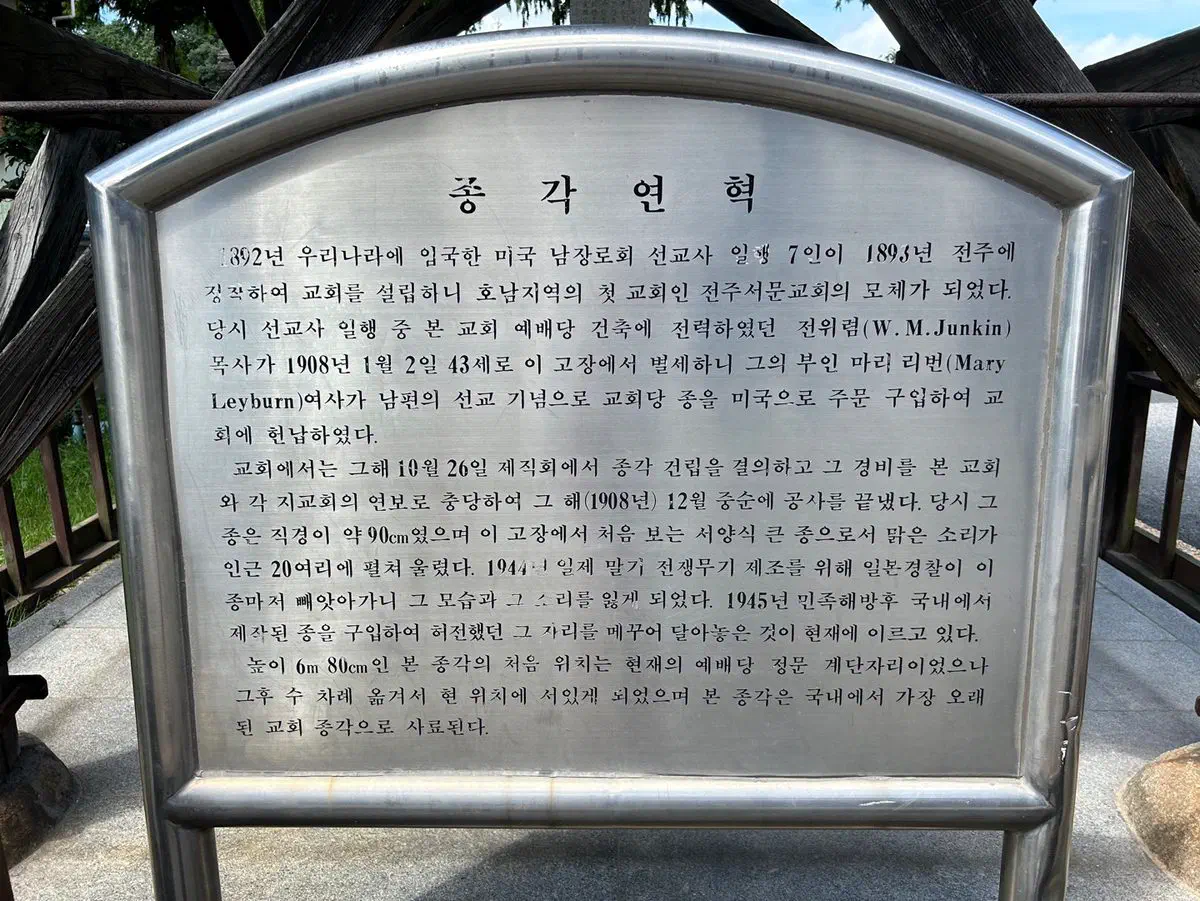
In December 1908 a bell was hung in a small wooden tower at a church in Jeonju. It was the first large Western-style bell anyone in the district had seen, and, according to the plaque at its foot, its sound carried about 20 ri, roughly 8 kilometers. Thirty-six years later Japanese police took it for the war effort. The tower is still there, with a replacement bell hung after liberation.
That bell is a good way into Jeonju’s Christian heritage, one of Korea’s quieter heritage stories. Between 1892 and the 1930s, a small group of American missionaries from the Southern Presbyterian church built a church, a hospital and a school in Jeonju. The hospital and the school are still there, a few hundred meters apart uphill from Hanok Village, and the church is nearby. We visited the school, the hospital, the church and the missionary cemetery. This page covers what happened, who the people were, what survives, and how to see it.
- What
- The church, hospital and school founded by the Southern Presbyterian mission in Jeonju
- Where
- The hospital, the school and Emmaus Love Hospital sit on one hillside, roughly 0.4 to 0.5 km apart in a straight line
- From Hanok Village
- About 1.1 to 1.5 km in a straight line, and uphill
- Church
- Jeonju Seomun Church, which has the 1908 bell tower
- Time
- Half a day for the hillside cluster and the church
- World Heritage
- Eight local governments are preparing a joint bid; the tentative-list application is targeted for December 2026
The seven who came in 1892
The Southern Presbyterian mission sent seven missionaries to Korea in 1892. They reached Korea in November. Their names, as the Mission recorded them:
- William D. Reynolds (이눌서) and Patsy Bolling Reynolds
- He led the first baptisms in Jeonju in 1897, and had spent about two years in Seoul on Korean Bible translation first
- Lewis B. Tate (최의덕)
- Settled in Jeonju near Christmas 1895; started what became Seomun Church; retired in 1925
- Mattie Tate (최마태)
- His sister; ran the women’s gatherings from her room in the Jeonju house
- William M. Junkin (전위렴) and Mary Leyburn Junkin (전마리아)
- Worked first from Gunsan, then Jeonju; he died on 2 January 1908, aged 43
- Linnie Davis
- The seventh pioneer; the Mission’s own anniversary verse remembers her for “errands of mercy”
They did not all work in Jeonju. Gunsan, the port on the coast, was one of the mission’s two starting points in the region, and the Junkins began there. The Jeonju story belongs mostly to the Tate siblings and to Reynolds, with Junkin arriving at the end.
Their arrival date at Jeonju depends on which source you read. A plaque at Seomun Church says the group settled in Jeonju in 1893. The Encyclopedia of Korean Culture says Lewis Tate and his sister settled there just before Christmas in 1895. Both can be true. In 1893 a Korean assistant named Jeong Hae-won bought a house for the mission in a village called Eunsong-ri. He is described in a Jeonju Ilbo history column as the first Korean to preach the Gospel in the Honam region. The missionaries themselves came later.
The village nobody can quite locate
Eunsong-ri, on the slope of Wansan hill beyond the city wall, was the mission’s first compound. A map drawn for King Gojong called Wansando-hyeong shows it as a cluster of houses, labeled in Chinese characters as American occupancy: three tile-roofed and five thatched buildings. Gojong had asked for a report on foreigners living on the hill.
Where exactly the first church stood is still argued. Three sites have been proposed: a vacant lot beside a church called Joeun Church, which a Christian council proposed in 2015 and the city signposted; a hillside near the Myeongnyun apartments, argued by a Jeonju University researcher from the King’s map; and a lot beside a small shop called Haengun Supermarket, based on early Seomun Church members’ recollections. At a third seminar in July 2026 a researcher presented a 1939 Jeonju map that he said strengthened the Haengun Supermarket case. One news headline called the site effectively settled, but the Jeonju Ilbo’s account of the same seminar says the scholars still disagreed.
For a visitor, this means there is no famous building to look at. What you are looking at is a hillside where a historical argument is happening.
One more detail from this period. The Encyclopedia of Korean Culture records that a woman in the neighboring thatched house, Mrs. Kim, watched the Tate siblings and noticed they did not hold ancestral rites. That curiosity led her to the women’s meetings in Mattie Tate’s room, and then to the church. The first baptisms were on 17 July 1897, at Tate’s house. Five people were baptized. Reynolds led the service, having arrived in June.
Seomun Church: the mother church of Honam
The congregation that grew from those meetings is Jeonju Seomun Church. The Encyclopedia of Korean Culture gives a short history of its buildings:
- 1905
- Moved to its present site, outside the old West Gate (seomun), with a brick-and-tile chapel of 50 pyeong
- 1908
- First session formed; Kim Pil-su became an elder
- December 1908
- Bell tower built in memory of William Junkin
- 1935
- A new two-story brick chapel
- 1981–83
- The present sanctuary, dedicated in 1983
- 2019
- Designated site no. 6 in the Presbyterian General Assembly’s list of Korean Christian historic sites
The bell tower is the reason to go. The plaque says Mary Leyburn Junkin ordered a church bell from the United States in her husband’s memory after his death. The congregation voted to build a tower on 26 October 1908 and finished it by mid-December. The bell, about 90 cm across, was a Western bell of a kind the neighborhood had not heard. In 1944 Japanese police took it for munitions. A domestically made bell was hung in 1945, and the plaque says the tower is regarded as the oldest church bell tower in Korea. It is 6.8 meters tall and has been moved several times; it first stood where the chapel’s front steps are now.
Jesus Hospital: a doctor who could not treat men
The hospital that grew out of the same compound started small. In 1898 an American woman doctor, Mattie B. Ingold, opened an outpatient clinic in a thatched house at Eunsong-ri. According to the director of the hospital’s museum, interviewed by CBS radio in 2023, she could treat only women and children. In late-nineteenth-century Korea a woman doctor could not examine adult men, so the clinic’s early records are of a boy with a dislocated hip and women with dislocated jaws.
The hospital moved to tile-roofed houses in 1902, and in 1912 a doctor named Thomas H. Daniel built a two-story red-brick hospital with 30 beds. It was the first of its kind in Honam. It got the nickname “the beautiful hospital”, partly for the roses.
In January 1935 it burned down. An electrical short started the fire before dawn, with 30 patients inside, women on the ground floor and men upstairs. A missionary nurse who slept in one of the wards heard it first and got every patient out, including a missionary’s four-day-old baby, and no one died. The mission had fire insurance. With donations raised by another missionary, it rebuilt in 1936.
That 1936 building still stands. It is now called Emmaus Love Hospital (엠마오사랑병원), a private care home that is no longer part of Jesus Hospital, with a red-brick front and ivy. The museum director says the view over Jeonju from there is good at night. The later milestones, from the encyclopedia and the museum director:
- 1898
- Ingold’s outpatient clinic for women and children opens
- 1912
- Brick hospital with 30 beds, the first in Honam
- 1935–36
- Fire, then rebuilding
- 1949
- A formal internship program, before the government required one
- 1950
- A nursing school
- 1971
- A new modern hospital built under Dr. David J. Seel (설대위), with funding the director says came from West Germany and the United States
- 1979
- A staff doctor sent to Bangladesh, which the encyclopedia calls the turning point from receiving mission help to giving it
The name was not the mission’s idea. The official names were Presbyterian Medical Center and a memorial hospital name that Koreans found hard to say. The director says patients started calling it Jesus Hospital (예수병원, Yesu Byeongwon) because they had been told about Jesus there, and the name stuck. It is the name the hospital goes by today, and in English it is still the Presbyterian Medical Center.
When we visited, the lobby wall carried eight bronze relief portraits of what appear to be past hospital directors, each with a name and years of service beneath. The hospital also has the Gu Paul Memorial Museum of Medicine (구바울기념의학박물관), named for a missionary doctor who rebuilt the hospital after the Japanese occupation and the Korean War. According to its director, it holds Ingold’s blouse and shoes, house-call bags, and early endoscopes that look thick and crude by modern standards. We have not confirmed its opening hours, so ask at the hospital’s information desk.
Sinheung School, built on a Confucian academy
The third institution is the school. Reynolds started it in September 1900 in his own house, with a single pupil, teaching Korean script and arithmetic. The Encyclopedia of Korean Culture says it moved in 1904 to the house of another missionary, William B. Harrison, where it had five teachers and about ten students.
In 1906 a missionary named Nisbet put up a school building on the site of Huihyeondang, a seowon, a Confucian academy. That is the sharpest image in the story: a school that taught the Bible, Korean, Chinese characters, English, history, geography, arithmetic, singing, drawing and gymnastics now stood where a Confucian academy had been. The school was called Yesugyo Hakgyo, “the Jesus school”, and soon Sinheung, which means new rising. It was licensed as a private school in 1909, and its first five graduates left that year.
Sinheung had a second life as a center of resistance to the Japanese colonial government. According to the encyclopedia, every student took part in the Jeonju demonstrations on 1 March 1919, and students later took part in the 1929 student movement and the 1932 secret-society and reading-circle incidents. Some students died for it.
Then, in 1937, it closed. The Japanese authorities pressed schools, including the mission’s, to join Shinto shrine worship. The mission decided to refuse, and in October 1937 it shut Sinheung rather than comply. By then the school had graduated 883 students from its primary course and 244 from the higher course. The primary pupils were transferred to a public school in Jeonju and the higher students to a middle school in Gochang. It reopened in 1946 as a junior middle school and became a high school again in 1950. The school marked its 110th anniversary in 2009.
Gijeon Girls’ School, the mission’s sister school for girls, has a parallel history. A Jeonju Ilbo history column says Mary Junkin became its first principal in 1909 and that it was renamed in her husband’s memory. We have not confirmed that from a second source.
The cemetery
Junkin lies in the Jeonju missionary cemetery. A column in the Jeonju Ilbo says he asked to be buried at Gunsan and was later moved. The same column says that beneath his headstone are the small markers of three sons who died of tropical illness.
We did not find an official source for the cemetery’s opening hours or access, and we do not want to guess. Check before you go. It is a burial ground, not a tourist attraction.
How the Koreans fit in
The standard version of this story has the missionaries as the main actors. The records, read carefully, give a more crowded picture.
- Jeong Hae-won, a Korean, bought the first house, interpreted for the missionaries and taught them Korean.
- Mrs. Kim, a neighbor, came to the women’s meetings out of curiosity and brought her 12-year-old son.
- Kim Pil-su became an elder when Seomun Church formed its session in 1908.
- Sinheung’s students put themselves in the 1919 independence demonstrations. The school was a Korean institution as well as an American one.
- Jang Pyeong-hwa, an elder, became principal when Sinheung reopened in 1946.
The museum director’s own summary is that missionaries’ schools, hospitals and church teaching trained people and kept them alive long enough to use the training. That is an argument made by someone inside the tradition, and a fair reading is that it is partly right. Korea’s modernization had many causes. The schools and hospitals were one real one.
A half-day route
This order is our suggestion, and we have not timed it.
- Jesus Hospital and the museum on the hillside. The cluster is compact: the hospital, Emmaus Love Hospital and Sinheung School are about 0.4 to 0.5 km apart in a straight line.
- Emmaus Love Hospital, from the outside only. It is a private care home.
- Sinheung School. It is a working school, so keep to what is visible from outside unless there is an open visitor arrangement.
- Seomun Church for the bell tower. Services take place on Sundays.
- Hanok Village afterwards, 1.1 to 1.5 km in a straight line from the hillside cluster.
Roads are longer than straight lines, and the hill is steep enough that a taxi from Hanok Village is the easier first leg. For navigation, our guide to getting around Korea says which map app to install. A Korean eSIM keeps it working. Our Jeonju guide covers getting there and where to sleep, and hanok stays in Jeonju are close to the start of this route. If you are in town in early October, read about the bibimbap festival at Deokjin Park too.
Jeonju Christian heritage and the World Heritage bid
Fifteen cultural-heritage items remain from the Jeonju mission, according to Korean news reports. They include the hospital and nursing school, missionary houses, the cemetery, Sinheung and Gijeon schools. In June 2025, eight local governments, Jeonju among them, launched a joint effort to put Korea’s missionary bases on the UNESCO World Heritage list. The target for applying to the tentative list is December 2026. A Korean report notes that no Protestant missionary heritage in Asia has been inscribed.
Inscription is years away if it comes at all. Meanwhile the sites are being researched and documented.
Quick answers
Who were the seven Southern Presbyterian pioneers?
When did the Jeonju mission begin?
Where was Jeonju's first church?
Why is it called Jesus Hospital?
Why did Sinheung School close in 1937?
Can I visit as a non-Christian?
Is the missionary cemetery open to visitors?
Checked 5 October 2026. We visited Sinheung School, Jesus Hospital, Seomun Church and the missionary cemetery. Most of the facts on this page come from published sources, listed here, and not from our own notes. The list of the seven missionaries is from the Southern Presbyterian mission history site kmhistory.com. Dates and details for Sinheung, Seomun Church and Jesus Hospital come from the Academy of Korean Studies’ Encyclopedia of Korean Culture entries on Jeonju Sinheung High School, Jeonju Seomun Church and Jeonju Jesus Hospital. The history of the hospital’s buildings, its name and its museum are from a CBS radio interview with the museum’s director, published by Nocut News in June 2023. The bell tower facts are from the plaque at the tower, photographed by DAYEON LEE and published on Wikimedia Commons under CC BY-SA 4.0. The Junkin family details come from a Jeonju Ilbo history column by Yun Ju. The first-church debate is from the Jeonju Ilbo’s report on the Wansando-hyeong and Nocut News coverage, and the July 2026 seminar is from Pressian. The World Heritage effort is from the Jeonju Ilbo.
Straight-line distances are computed from OpenStreetMap coordinates for the hospital, Sinheung School, Emmaus Love Hospital and Gyeonggijeon in Hanok Village. We did not locate Seomun Church or the cemetery in OpenStreetMap, so no distance is given for them.