Sansa: Korea's Seven UNESCO Mountain Monasteries
Last verified: 2026-09-18. Rules and prices change — always confirm on the official site before you travel.
This page contains affiliate links. If you book through them we may earn a commission at no extra cost to you. It never changes what we recommend.
Korea has seven mountain temples that UNESCO inscribed as a single World Heritage site in 2018 — not for any one building, but for something harder to photograph: they are still working monasteries, founded in the 7th to 9th centuries and never abandoned, each built around the same open courtyard layout that has nothing in common with a single-hall city temple. Our Songnisan hiking guide already covers one of the seven, Beopjusa, and its 2023 exemption from Korea’s nationwide temple-fee change. This page covers the other six — and which ones a visitor without a car can actually reach.
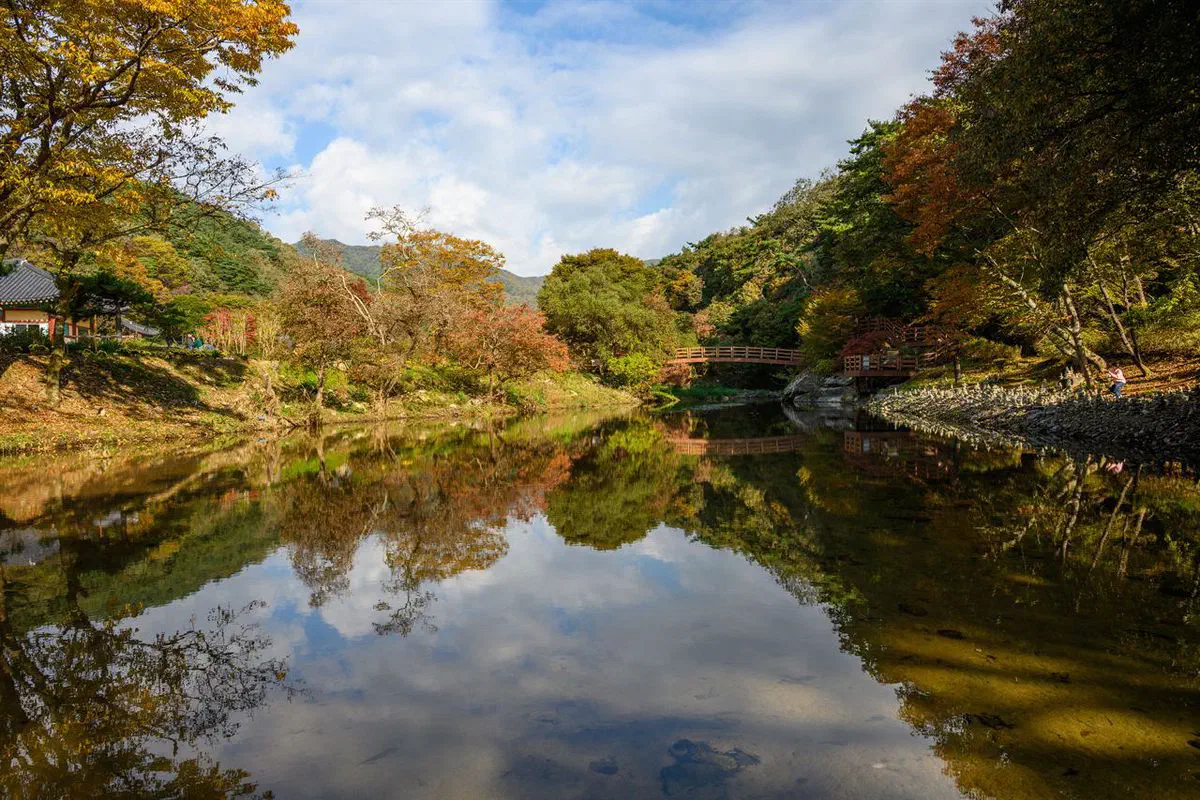
The seven, and what UNESCO actually inscribed
“Sansa, Buddhist Mountain Monasteries in Korea” was inscribed at UNESCO’s 42nd World Heritage Committee session in 2018, under the criterion that the site bears exceptional testimony to a still-living cultural tradition — not a set of ruins. What ties the seven together is a shared spatial plan: a central madang (open courtyard) ringed by a Buddha hall, a lecture hall, a pavilion and monks’ quarters, a layout distinct from anywhere else in East Asian Buddhist architecture. Each temple remains separately protected under Korean law, with the Jogye Order and Korea Heritage Service jointly managing the site as a whole.
- Tongdosa
- Yangsan, Gyeongsangnam-do | 646 CE | Enshrines Buddha relics instead of a statue
- Bongjeongsa
- Andong, Gyeongsangbuk-do | c. 672 CE | Korea’s oldest confirmed wooden building
- Buseoksa
- Yeongju, Gyeongsangbuk-do | 676 CE | Birthplace of Korea’s Hwaeom Buddhist school
- Seonamsa
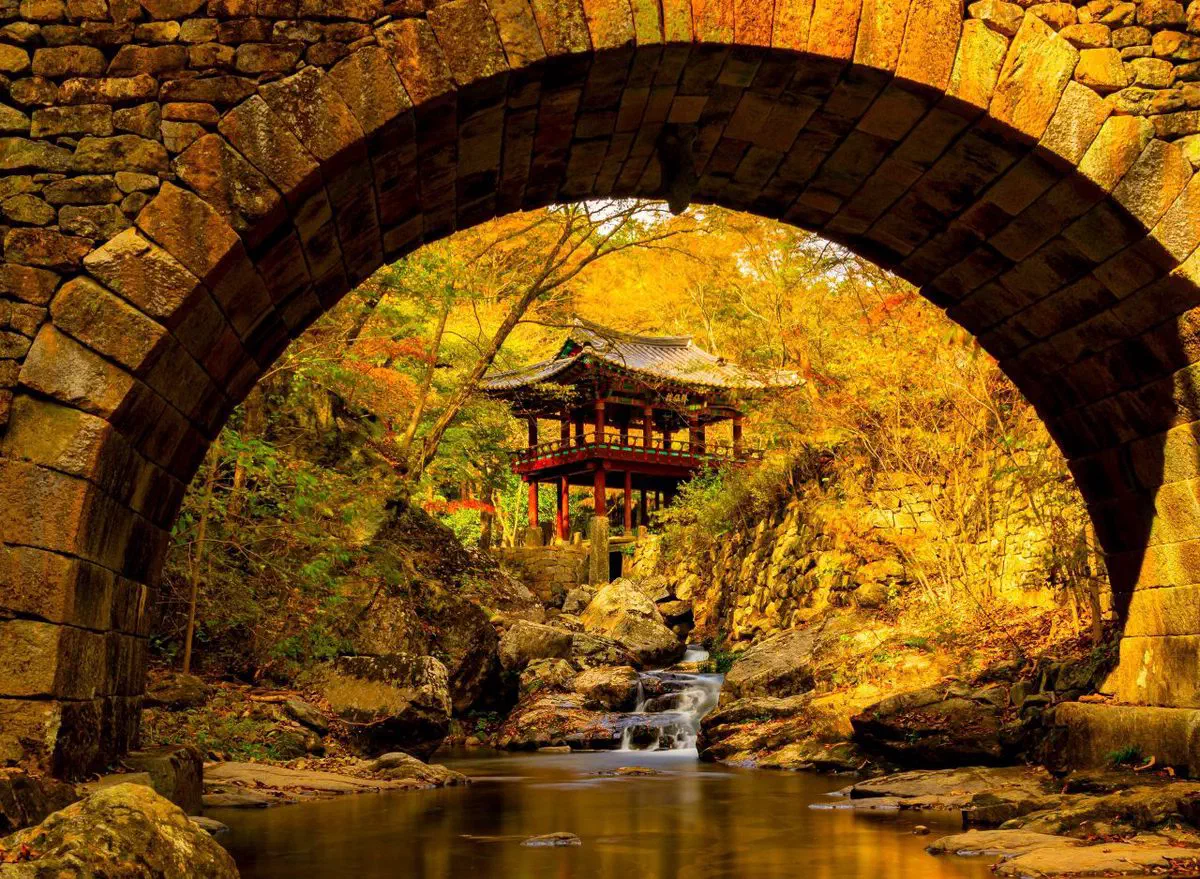
- Suncheon, Jeollanam-do | traditionally 9th century | Seungseongyo, a carved stone arch bridge
- Daeheungsa
- Haenam, Jeollanam-do | traditionally 9th century | Base of a 1592 monk-militia resistance
- Magoksa
- Gongju, Chungcheongnam-do | traditionally 7th century | Untouched by the 1592–98 Imjin War
- Beopjusa
- Boeun, Chungcheongbuk-do | mid-8th century | Korea’s only surviving 5-story wooden pagoda
Founding dates for several of these rest on temple tradition rather than firm archaeological record — Daeheungsa’s and Magoksa’s especially are disputed even among Korean sources, so treat “traditionally” as doing real work in that table.
Which ones you can actually reach
None of the seven sit in Seoul, and access varies enormously.
Magoksa (Gongju) is the realistic Seoul day trip. A KTX from Yongsan to Gongju runs about 70 minutes, followed by a local bus and a short walk — the only one of the seven where a car genuinely isn’t necessary.
Tongdosa (Yangsan) is the easy trip if you’re based in Busan instead — Subway Line 1 to Nopo Station, then about 30 minutes by bus. From Seoul, it’s a long day: KTX to Ulsan or Busan, then bus transfers.
Buseoksa (Yeongju), Bongjeongsa (Andong) and Seonamsa (Suncheon) are all reachable by train plus local bus from Seoul, but each is a 5+ hour round trip minimum — workable as a long day, more comfortable as an overnight, and Bongjeongsa pairs naturally with a visit to Andong’s Hahoe Village.
Daeheungsa (Haenam) is not a realistic day trip from Seoul. There’s no direct train; getting there means an express bus routed through Gwangju, 5 to 5.5 hours each way. Treat it as part of a multi-day Jeolla itinerary or a guided tour, not a solo add-on.
Since Korea’s temples stopped charging admission
Every major Korean temple, these seven included, dropped its long-standing entry fee on 4 May 2023, funded by a government allocation rather than temple revenue. Reporting since then describes a sharp rise in visitor numbers to the towns around these temples, though we could not find hard year-over-year figures broken out for each of the seven specifically — the qualitative trend is well documented, the precise numbers less so.
One recent event underlines how seriously these sites are now protected: during Korea’s record wildfires in March 2025, officials at Bongjeongsa cut down a roughly 200-year-old pine tree on the temple grounds specifically to stop the fire from reaching its UNESCO-listed wooden halls. The tactic worked — Bongjeongsa survived intact, in contrast to nearby Gounsa, an older, non-Sansa temple that lost 21 of its 30 buildings in the same fires.
Staying the night: templestay
Four of the seven — Tongdosa, Beopjusa, Magoksa and Daeheungsa — run temple stay programs specifically set up for international participants, with English-language guidance. Bookings go through the Jogye Order’s official site, eng.templestay.com, not a third-party platform. Typical pricing runs ₩40,000–₩80,000 a night including meals and guided activities; Magoksa was among a group of temples offering a discounted ₩30,000 foreigner rate through late 2025. Confirm current availability directly on the templestay site before planning around a specific temple — schedules and participating temples change.
A guided hiking day out is a reasonable way to see Korean mountain scenery without planning transit yourself, though none of the seven Sansa temples currently appear on standard Seoul day-tour itineraries — they reward a dedicated trip.
What does "Sansa" mean?
Which Sansa temple is easiest to visit from Seoul?
Do any of the seven Sansa temples still charge admission?
Can foreign visitors do a temple stay at a Sansa temple?
Checked 18 September 2026. UNESCO inscription details and criteria from Korea Heritage Service and UNESCO World Heritage Committee decision records (Decision 42 COM 8B.23); direct access to whc.unesco.org was blocked during research, so verify exact UNESCO wording independently if quoting it directly. Individual temple founding dates and features cross- checked against Wikipedia, Korea Heritage Service heritage records, and individual temple sources — flagged in the text where traditions conflict. Transit times and routes from Rome2Rio and temple-visit trip reports; the 2023 fee abolition from Korea Times, May 2023. The March 2025 Bongjeongsa wildfire response from ETV Bharat, 27 March 2025. Templestay program availability from Korea.net and eng.templestay.com — confirm directly before booking, as participating temples and pricing change.