Songnisan Hiking: The Temple Fee That Stood for 56 Years
Last verified: 2026-09-10. Rules and prices change — always confirm on the official site before you travel.
This page contains affiliate links. If you book through them we may earn a commission at no extra cost to you. It never changes what we recommend.
Songnisan hiking runs through Korea’s inland mountain country — North Chungcheong’s Boeun County, no coast within a few hours in any direction — and for 56 years, walking into its main temple cost money. That changed nationwide in 2023, and Songnisan’s own visitor numbers show exactly how much the fee had been holding people back.
The fee that stood for 56 years, and its 2023 end
On May 4, 2023, Korea abolished the “cultural heritage viewing fee” (문화재관람료) that 65 temples nationwide, including Beopjusa, had charged at their gates for decades. Beopjusa’s own fee — ₩4,000 for adults, ₩2,500 for students and soldiers, ₩1,000 for children — had run for 56 years before it disappeared.
The effect was immediate and measurable. Yonhap News reported Beopjusa’s visitor count rose 11.1% in 2023 alone, and local reporting into 2025 credits the fee’s removal — alongside new forest recreation facilities in Boeun County — with continuing to draw visitors back to the area. If an older guide still mentions an entrance fee at Beopjusa, that information is out of date.
Songnisan hiking’s other draw: Beopjusa’s UNESCO listing
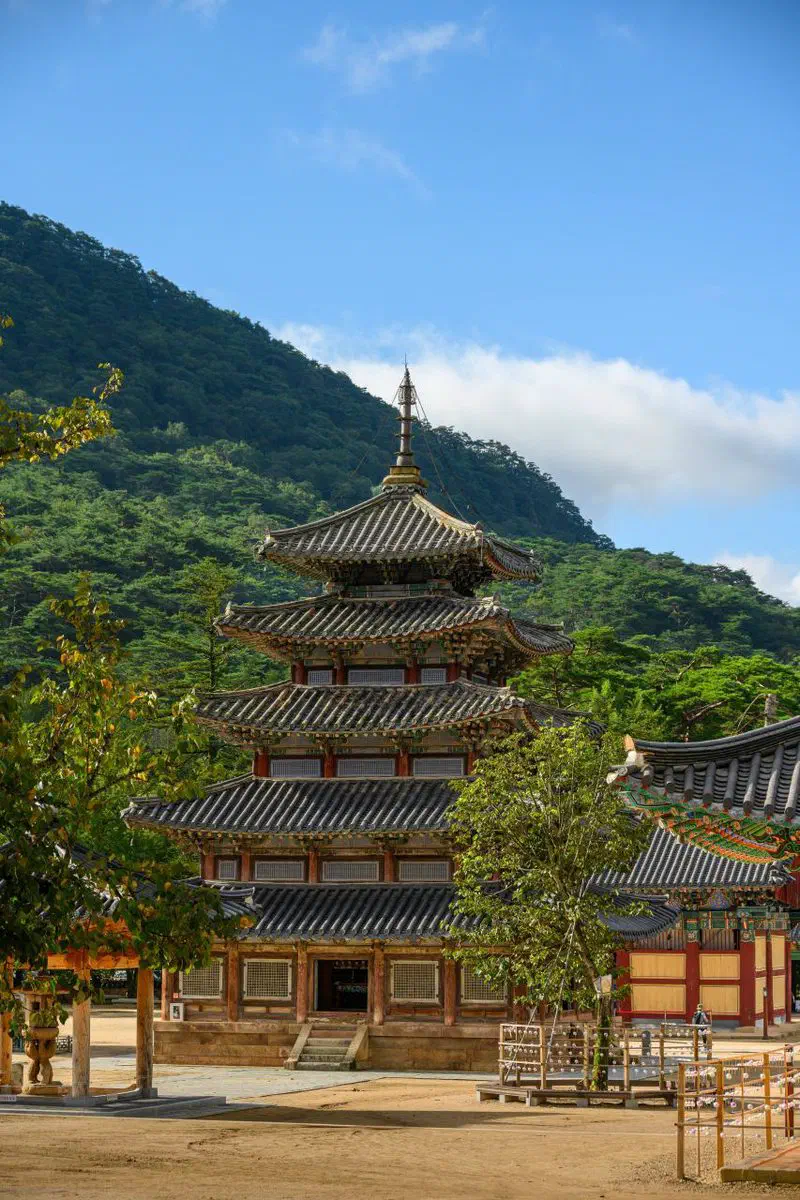
A monk named Uisin founded Beopjusa in 553 CE, and its most striking building is Palsangjeon, Korea’s only surviving wooden five-story pagoda and a National Treasure. Nearby stands a 33-meter gilt-bronze Maitreya Buddha, a modern recasting of a tradition that traces back to a bronze statue monks first cast in 776 CE. A twin-lion stone lantern and a stone lotus pond from 720 CE — both National Treasures in their own right — sit on the same temple grounds. UNESCO inscribed Beopjusa in 2018 as one of seven temples in its “Sansa, Buddhist Mountain Monasteries in Korea” listing — the other six, and which ones you can actually reach without a car, are covered separately.
Munjangdae draws more hikers than the mountain’s real summit
Songnisan’s highest point is Cheonwangbong, at 1,058 meters — but it isn’t where most hikers are actually headed. Munjangdae, a second peak just 4 meters lower at 1,054 meters, draws more visitors than the true summit, according to the park’s own trail data. Its draw is a single massive flat boulder at the top, wide enough to seat around 50 people at once — a natural viewing platform rather than a narrow rock point.
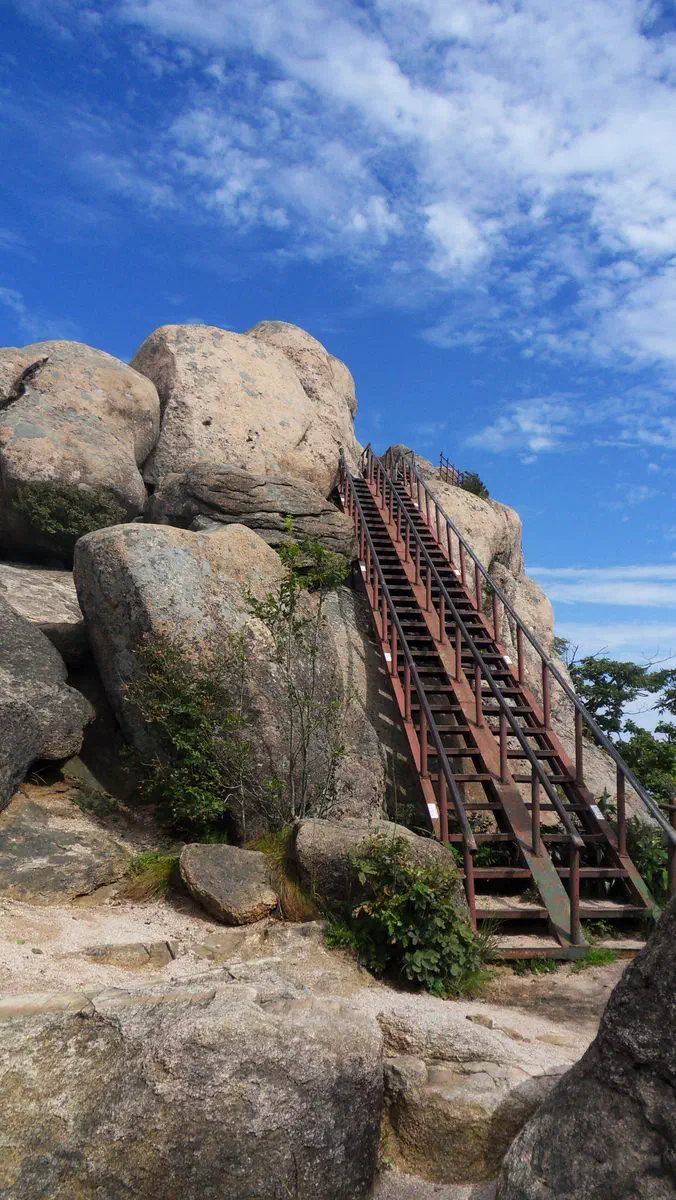
Two routes reach it: from Beopjusa, via Sesimjeong and Jungsajaam, about 3.5 hours one way; from Hwabuk-myeon on the Sangju (Gyeongbuk) side, about 2.5 hours one way, or 4 hours round trip. Hikers reach Cheonwangbong itself from Beopjusa in about 3.5 hours as well, on a route most describe as gentler than the climb to Munjangdae.
- Cheonwangbong (true summit)
- 1,058 m — about 3.5 hours from Beopjusa, gentler grade
- Munjangdae (more visited)
- 1,054 m — a 50-person flat boulder summit, 3.5 h from Beopjusa or 2.5 h from the Sangju side
- Beopjusa entry fee
- Abolished May 4, 2023, after 56 years — visitor numbers rose over 11% the same year
- Beopjusa's National Treasures
- Palsangjeon (only surviving wooden 5-story pagoda), a 33 m bronze Buddha, a twin-lion lantern, a stone lotus pond
- UNESCO status
- Inscribed 2018, part of “Sansa, Buddhist Mountain Monasteries in Korea”
- National park status
- Korea’s 6th (1970), spanning Boeun and Goesan (Chungbuk) and Sangju and Mungyeong (Gyeongbuk)
Getting there
Direct express buses run from Dongseoul, Central City and Seoul Nambu Terminals to Songnisan Terminal, roughly 2.5 to 3.5 hours depending on the route. Beopjusa’s own website recommends an alternative for anyone coming from Seoul: bus to Cheongju first — which has far more frequent departures — then a local bus onward, about 1.5 hours from there. Our intercity bus guide covers booking either way as a foreigner.
A Korean eSIM is worth having before you go — Boeun County’s bus connections change by season, and Naver Map tracks local bus arrivals more reliably than Google Maps does outside Seoul.
In the same trip
Other museums within reach
- Cheongju National Museum — Cheongju, North Chungcheong, about 31 km away.
Festivals near here
These run on their own dates, so check them against yours before you build a route around them.
- Mungyeong Chasabal Festival — May, about 33 km away.
- Yeongdong Nangye Korean Traditional Music Festival — October, about 43 km away.
- Daejeon Science Festival — April, about 44 km away.
- Eumseong Pumba Festival — June, about 45 km away.
- Gimcheon Gimbap Festival — October, about 51 km away.
Quick answers
Is there still an entrance fee to visit Beopjusa?
Which is Songnisan's actual highest peak?
Is Beopjusa a UNESCO World Heritage Site?
What is Palsangjeon?
Checked 10 September 2026. The May 4, 2023 nationwide abolition of the cultural heritage viewing fee, Beopjusa’s former fee amounts, and its 56-year history from Newsis, Yonhap News, and local Boeun-area press covering the policy change and its aftermath; the 11.1% visitor increase from Yonhap’s own follow-up reporting. Beopjusa’s founding date, its National Treasures (Palsangjeon, the gilt-bronze Buddha, the twin-lion stone lantern, the stone lotus pond), and its 2018 UNESCO “Sansa” inscription from Yonhap News coverage of the listing and Korean heritage-site reporting. Songnisan’s 1970 national park designation, its administrative span, and the Munjangdae and Cheonwangbong route distances, times, and relative visitor numbers from Korean Wikipedia’s Songnisan entry, which cites the original 1970 park-designation gazette and the park authority’s own trail-course pages. Bus routes and travel times from Seoul from Korean transit-blog sources and Beopjusa’s own official access guidance. Fees, reservation rules and bus schedules change; confirm before you plan a day around any of this.