Buyeo National Museum: A Whole Building for One Object
Last verified: 2026-08-31. Rules and prices change — always confirm on the official site before you travel.
This page contains affiliate links. If you book through them we may earn a commission at no extra cost to you. It never changes what we recommend.
On 23 December 2025, Buyeo National Museum opened a new three-story building. It cost ₩21.1 billion and took five years, and it holds one object.
The museum’s own description of what it had done is the clearest version: this is the first time a whole building, rather than a room inside one, has been made in Korea for a single piece.
The object
The Gilt-bronze Incense Burner of Baekje is 61.8 cm tall and weighs 11.8 kg. It is National Treasure No. 287. A phoenix stands on the lid, and below it the body rises as a landscape of mountains crowded with animals, musicians and figures.
It came out of the ground in 1993, from a wooden-framed water channel at the Neungsan-ri temple site in Buyeo. Waterlogged burial is why it survived in the condition it did.
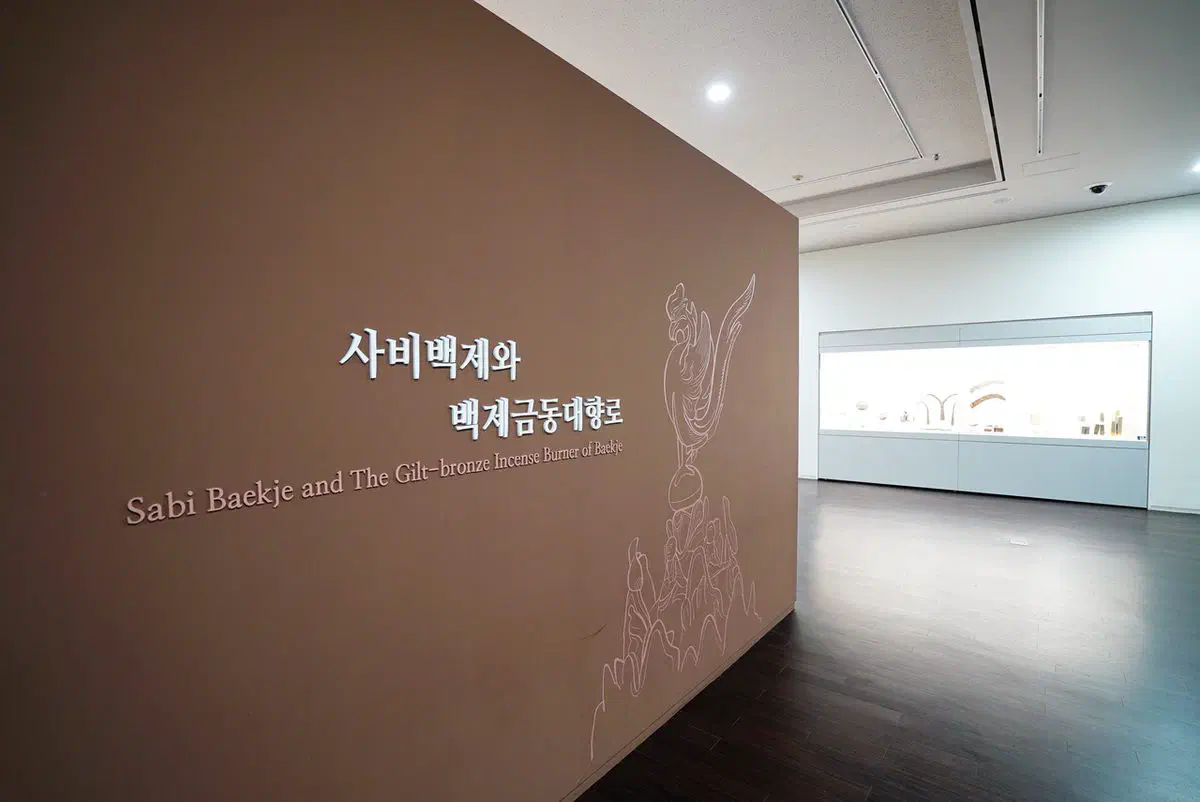
The new Baekje Great Incense Burner Hall puts it on the third floor, alone, in a dark room of about 254 m². The ground floor connects back to the existing permanent galleries and runs media work based on the underwater world carved around the censer’s base. The building’s own levels were designed to echo the structure of the object inside it.
Whether one bronze censer justifies twenty-one billion won is a fair question and not one we can settle. What is not in question is that Korea has decided this specific object carries that much weight.
Buyeo was the capital, and it is still called Buyeo
In 538, King Seong moved Baekje’s capital from Ungjin — modern Gongju — down the river to Sabi, and renamed the state Nambuyeo, South Buyeo. Ungjin had been defensible but cramped. Sabi had open plains and, through the Geum River, a route to the sea.
Sabi lasted 122 years. In 660 a Silla army under King Muyeol, allied with Tang China, took the city, and Baekje ended.
The county is still named after the state that King Seong renamed. The capital’s name outlived the capital by thirteen centuries.
- 475–538
- Ungjin period — the capital at Gongju
- **538**
- King Seong moves to Sabi and renames the state South Buyeo
- 538–660
- Sabi period, 122 years — Buyeo is the capital
- **660**
- Sabi falls to Silla and Tang; Baekje ends
- 1993
- The censer is dug out of a waterlogged pit at Neungsan-ri
- **2015**
- Baekje Historic Areas inscribed by UNESCO — Korea’s 12th
- **2025**
- A building opens for the censer alone
Half of a World Heritage property is in this one county
UNESCO inscribed the Baekje Historic Areas on 4 July 2015 at the 39th session in Bonn — Korea’s twelfth World Heritage property. It is a serial listing of eight components across three cities, covering late Baekje from 475 to 660.
Gongju holds two. Iksan holds two. Buyeo holds four: the Gwanbuk-ri site and Busosanseong fortress, the Jeongnimsa temple site, the Buyeo royal tombs at Neungsan-ri, and the Naseong city wall.
Two of them are a short walk from the museum. The Jeongnimsa pagoda is about 600 meters away, and Gwanbuk-ri and Busosanseong about 1.1 km.
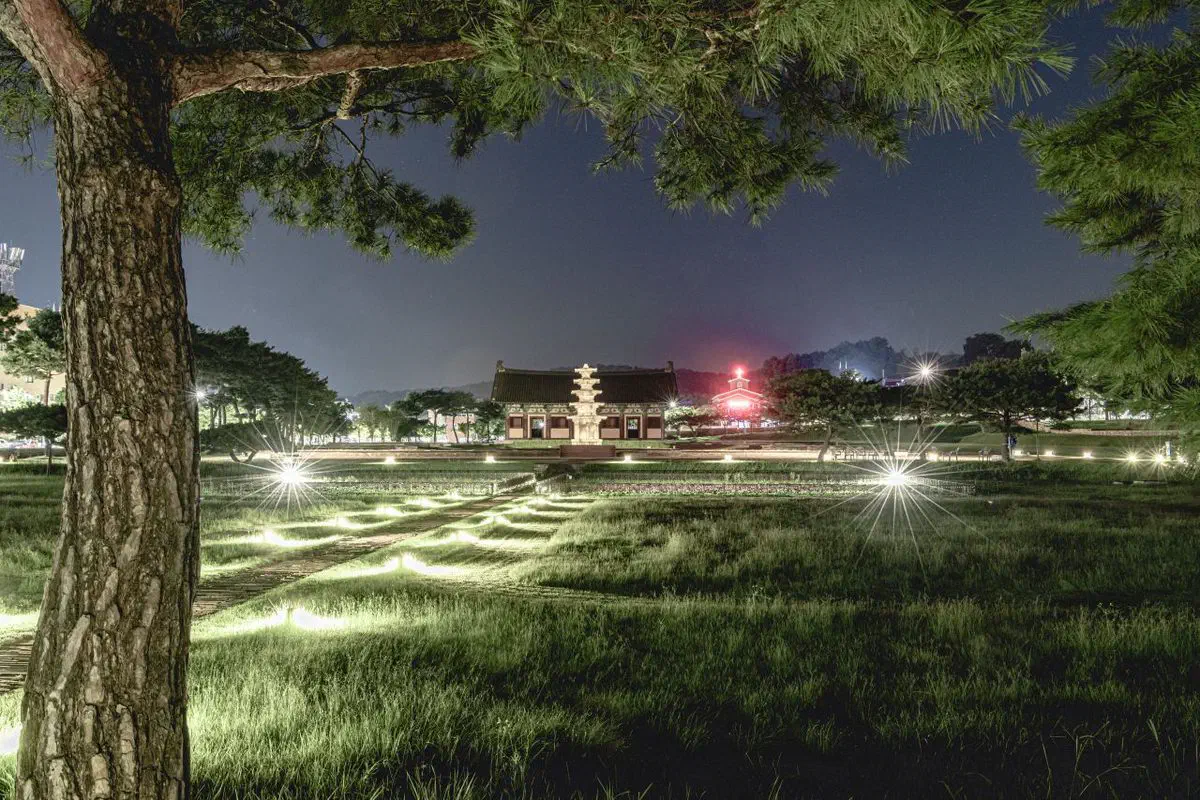
That photograph is the argument for coming to Buyeo rather than reading about Baekje. The temple buildings burned or rotted centuries ago. What survives is one pagoda and a floor plan in the grass — and the censer, which survived because it fell into water.
Our guide to Gongju’s museum covers the capital before this one, and Iksan the sites of the period after. The three run in order, and they are within about 60 km of each other.
Free, closed Mondays, and open late on summer Saturdays
Admission to the permanent galleries is free.
The hours are worth reading properly, because this museum keeps the most generous schedule of any national museum on our museum map:
- Standard
- 09:00–18:00, last entry an hour before
- Saturdays and holidays
- 09:00–19:00
- April–October Saturdays
- 09:00–21:00
- Closed
- Mondays, 1 January, Seollal, Chuseok
A national museum open at nine in the evening is unusual, and it lines up with the season when Buyeo’s lit sites — Jeongnimsa, Gungnamji pond — are worth seeing after dark anyway.
The Monday closure is the norm rather than the exception: ten of Korea’s fourteen national museums close on Mondays. Only Seoul, Gyeongju, Jeonju and Gwangju stay open.
Getting there
Buyeo has no train station. It is reached by intercity bus, most usefully from Seoul’s Nambu Terminal, or as a stop on a Gongju–Buyeo–Iksan run by car. If you are coming from the west coast, the Ecorium at Seocheon is about 32 km away and pairs with this as a very different sort of day.
Stays in Buyeo are genuinely thin: the platform listed five properties in the whole county when we checked on 31 August 2026. This is a county of small towns rather than a city, and most visitors come as a day trip for that reason. A Korean eSIM matters for rural bus timings, which live in Kakao Map and Naver Map; Google Maps will not route you.
In the same trip
Other museums within reach
- Gongju National Museum — Gongju, South Chungcheong, about 27 km away.
- Iksan National Museum — Iksan, North Jeolla, about 31 km away.
- National Institute of Ecology (Ecorium) — Janghang, Seocheon, South Chungcheong, about 32 km away. Sea and ecology rather than history.
Festivals near here
These run on their own dates, so check them against yours before you build a route around them.
- Nonsan Strawberry Festival — March, about 19 km away.
- Hansan Ramie Fabric Cultural Festival — June, about 24 km away.
- Gyeryong Military Culture Festival — October, about 29 km away.
- Boryeong Mud Festival — July, about 37 km away.
- Sejong Hangeul Festival — October, about 40 km away.
Quick answers
What is the Baekje Gilt-bronze Incense Burner?
Why did Buyeo National Museum build a whole building for one object?
Is Buyeo National Museum free?
How many UNESCO sites are in Buyeo?
Why is Buyeo called Buyeo?
Checked 31 August 2026. The Baekje Great Incense Burner Hall’s 23 December 2025 opening, its three floors, the ₩21.1 billion cost over five years, the roughly 254 m² third-floor room, the ground-floor media work and the museum’s claim that this is the first whole building in Korea made for a single object, from the museum’s own announcement and Korean press coverage of the opening. The censer’s 61.8 cm height, 11.8 kg weight, designation as National Treasure No. 287 and 1993 excavation from a wooden water channel at the Neungsan-ri temple site from Korea Heritage Service records. The 538 move to Sabi under King Seong, the renaming of the state to Nambuyeo, the 538–660 Sabi period and the 660 fall to the Silla–Tang alliance from Korean historical reference sources. The Baekje Historic Areas inscription on 4 July 2015 at the 39th session of the World Heritage Committee in Bonn, its status as Korea’s twelfth World Heritage property, and the eight components split two–four–two between Gongju, Buyeo and Iksan, from the Korean National Commission for UNESCO and Korea Heritage Service materials. Hours, the Monday closure and the April–October Saturday extension from the museum’s visitor information. Distances from Korea Tourism Organization location data. Hours change — confirm before you travel.