Gimhae National Museum: The Kingdom Left Out of the Name
Last verified: 2026-08-31. Rules and prices change — always confirm on the official site before you travel.
This page contains affiliate links. If you book through them we may earn a commission at no extra cost to you. It never changes what we recommend.
Korea’s ancient period is taught as the Three Kingdoms. There were four.
Gaya occupied the lower Nakdong River from around the first century CE until the sixth, which is roughly as long as Baekje lasted, and it is not in the name. Gimhae National Museum exists to deal with that, and it starts making its argument before you are through the door.
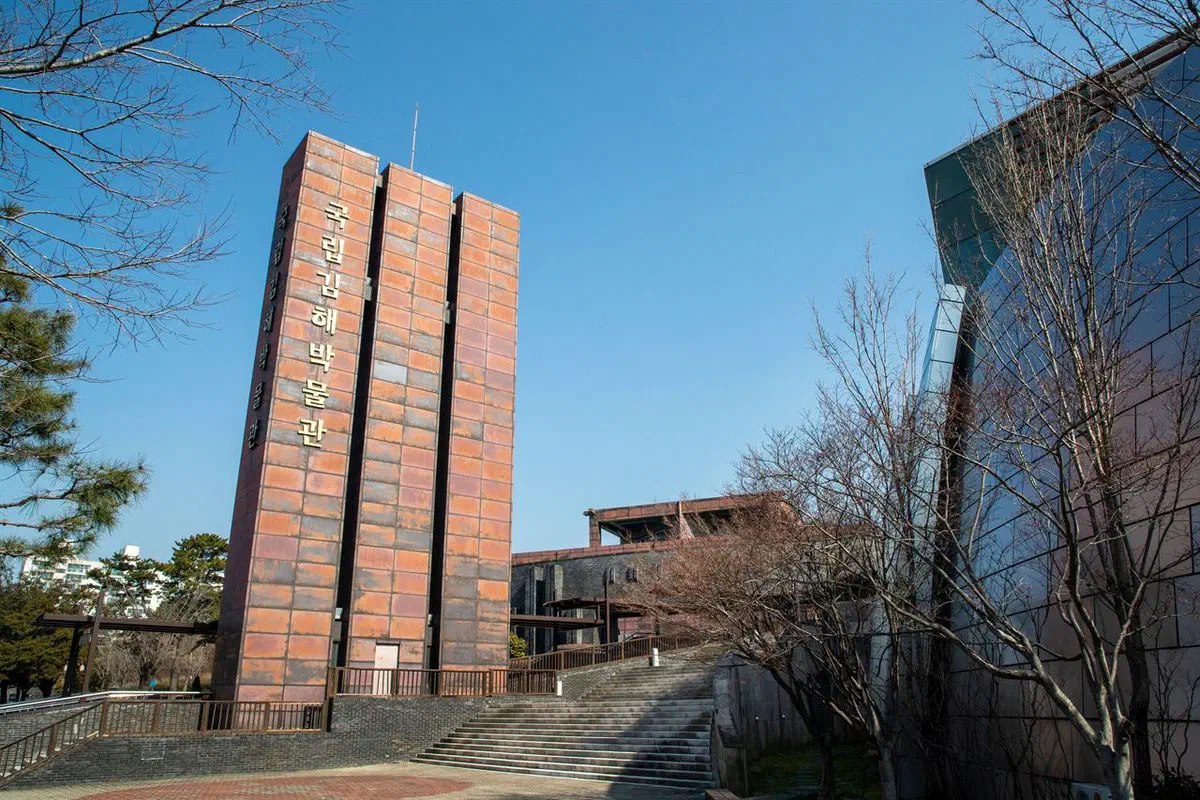
The building is the thesis
The museum opened on 29 July 1998, and its main hall is faced in black brick chosen to image iron ore and charcoal. That is not decoration. It is the shortest possible summary of why Gaya mattered.
Chinese records make the point in writing. The Records of the Three Kingdoms describe this region exporting iron to the other Samhan polities, to Dongye, to Japan, and to the Chinese commanderies of Lelang and Daifang.
Gimhae had good ore. Gaya turned it into weapons, armor, and ingots that circulated as something close to currency — iron bars used the way coins would be used later.
A kingdom whose export was the raw material of war, in a period defined by war, is not a minor player. It is a supplier to everyone.
The building is also the last work of the architect Jang Se-yang, who died in 1996, two years before it opened. And it sits at the foot of Gujibong, the hill where Gaya’s own founding story takes place.
Why it was left out, and why UNESCO listed it
Here is the part that makes the museum worth a detour rather than a stop.
Gaya never centralized. It stayed a confederacy of autonomous polities — Geumgwan Gaya at Gimhae first, later Daegaya at Goryeong — rather than consolidating under one court.
That is the standard explanation for why it lost. Silla and Baekje built centralized states; Gaya did not. So it was absorbed piece by piece rather than defeated once.
Geumgwan Gaya ended in 532, when its tenth and last king, Guhyeong, travelled to Silla’s King Beopheung with his three sons and surrendered. Daegaya ended in 562, broken by a Silla army under the general Isabu.
Then in September 2023, UNESCO inscribed the Gaya Tumuli on the World Heritage list — Korea’s sixteenth property — and the committee’s stated reason for the inscription is precisely the thing that got Gaya written out of the name. It cited Gaya as evidence of a civilization that kept an autonomous, horizontal political system while coexisting with the centralized states around it.
The trait that lost Gaya the war is the trait that got it onto the list.
- 1st–6th c. CE
- Gaya on the lower Nakdong — a confederacy, never one kingdom
- 2nd–3rd c.
- Iron exported to the Samhan, Dongye, Japan, Lelang and Daifang
- **532**
- Geumgwan Gaya’s last king surrenders to Silla
- **562**
- Daegaya falls to Silla’s general Isabu; Gaya ends
- 1998
- Gimhae National Museum opens, faced in iron-colored brick
- **2023**
- Gaya Tumuli inscribed by UNESCO — Korea’s 16th World Heritage site
One of the seven UNESCO sites is 800 meters away
The Gaya Tumuli inscription is a serial property of seven tomb clusters: Daeseong-dong at Gimhae, Malisan at Haman, Okjeon at Hapcheon, Songhak-dong at Goseong, Gyo-dong and Songhyeon-dong at Changnyeong, Yugok-ri and Durak-ri at Namwon, and Jisan-dong at Goryeong.
Daeseong-dong is about 800 meters from the museum. This is the practical reason to come here rather than to one of the other six: the finds and the ground they came out of are a ten-minute walk apart, and the tomb of King Suro — Geumgwan Gaya’s founder — is about a kilometer away in the other direction.
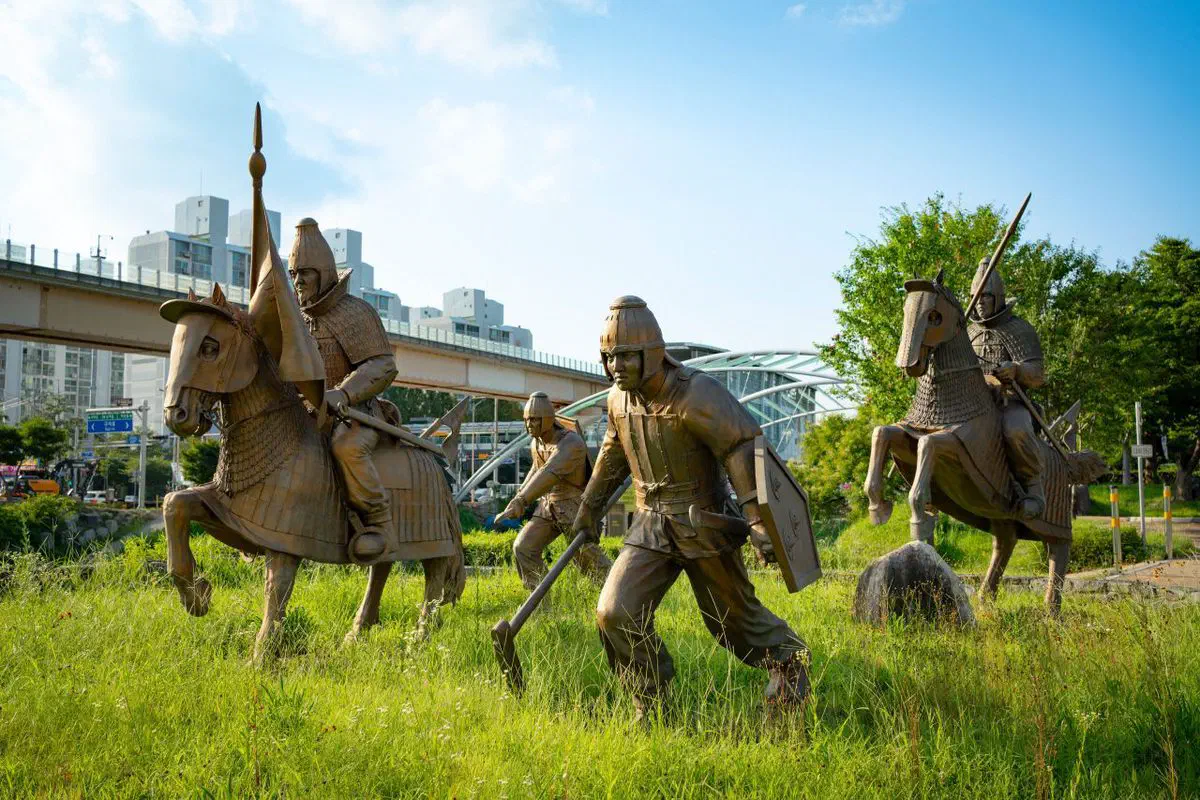
That background matters. Daeseong-dong is not a remote archaeological park. It is a hill with apartment blocks and an elevated road behind it, and the walk from the museum runs through town.
What it costs and when it shuts
Admission to the permanent galleries is free. It runs 09:00 to 18:00 with last entry at 17:30.
It closes Mondays, and that is the norm rather than the exception: ten of Korea’s fourteen national museums close on Mondays. Only Seoul, Gyeongju, Jeonju and Gwangju stay open, and they are marked on our museum map. A Monday in Gimhae will not work.
Getting there
The station is called Museum Station, and its English name on the line map is Gimhae National Museum. It is stop 18 on the Busan–Gimhae Light Rail, which runs from Sasang on Busan Metro Line 2 out through Gimhae.
That makes this a half-day trip from Busan rather than a separate destination. Gimhae International Airport is on the same line, so the museum is also an unusually easy thing to do on an arrival or departure day with hours to spend — few national museums have their own named station on the way to the airport.
If you are already going to be in Busan, our two days in Busan covers the city’s fare zones, and the National Maritime Museum on Yeongdo pairs with this one as the other side of the same coast.
Stays in Busan are the practical base — Gimhae’s own hotel stock is thin and built for the airport. A Korean eSIM covers the light rail and bus timings, since Google Maps will not route you.
In the same trip
Other museums within reach
- National Maritime Museum of Korea — Yeongdo, Busan, about 26 km away. Sea and ecology rather than history.
Festivals near here
These run on their own dates, so check them against yours before you build a route around them.
- Gimhae Buncheong Ceramics Festival — November, about 12 km away.
- Busan International Rock Festival — October, about 12 km away.
- Dongnae Eupseong History Festival — October, about 20 km away.
- Jinhae Gunhangje Festival — March, about 22 km away.
- Gwangalli Eobang Festival — June, about 24 km away.
The coast from here
- The Namparang Trail — Oryukdo, Nam-gu, Busan, about 28 km away. The trail itself runs 1,470 km along the south coast, so it likely passes closer than this.
Filmed near here
- Busan K-Pop Locations — Gamcheon, Saha-gu, Busan, about 20 km away.
Quick answers
Why is Gaya not one of the Three Kingdoms?
Is Gimhae National Museum free?
Are the Gaya Tumuli a UNESCO site?
What is near Gimhae National Museum?
How do you get to Gimhae National Museum from Busan?
Checked 31 August 2026. Opening hours, the Monday closure and free permanent admission from the museum’s own visitor information. The 29 July 1998 opening, the black brick imaging iron ore and charcoal, the Gujibong siting and the building as architect Jang Se-yang’s posthumous work from the museum’s materials and Korean reference sources. Gaya’s iron exports to the Samhan, Dongye, Japan, Lelang and Daifang, and the use of iron ingots as a medium of exchange, are recorded in the Records of the Three Kingdoms and summarised by the National Institute of Korean History. Geumgwan Gaya’s surrender under King Guhyeong in 532 and Daegaya’s fall to Isabu in 562 from Korean historical reference sources. The Gaya Tumuli inscription at the 45th session of the World Heritage Committee in September 2023, its status as Korea’s sixteenth World Heritage property, the seven component tomb clusters and the committee’s citation of Gaya’s autonomous political system from the Korean National Commission for UNESCO and Ministry of Foreign Affairs announcements. Distances to Daeseong-dong and the tomb of King Suro from Korea Tourism Organization location data. Hours change — confirm before you travel.