Gongju National Museum: The Tomb They Emptied in a Night
Last verified: 2026-08-31. Rules and prices change — always confirm on the official site before you travel.
This page contains affiliate links. If you book through them we may earn a commission at no extra cost to you. It never changes what we recommend.
On 8 July 1971, workmen digging a drainage channel between two known tombs at Gongju hit a brick wall that was not supposed to be there.
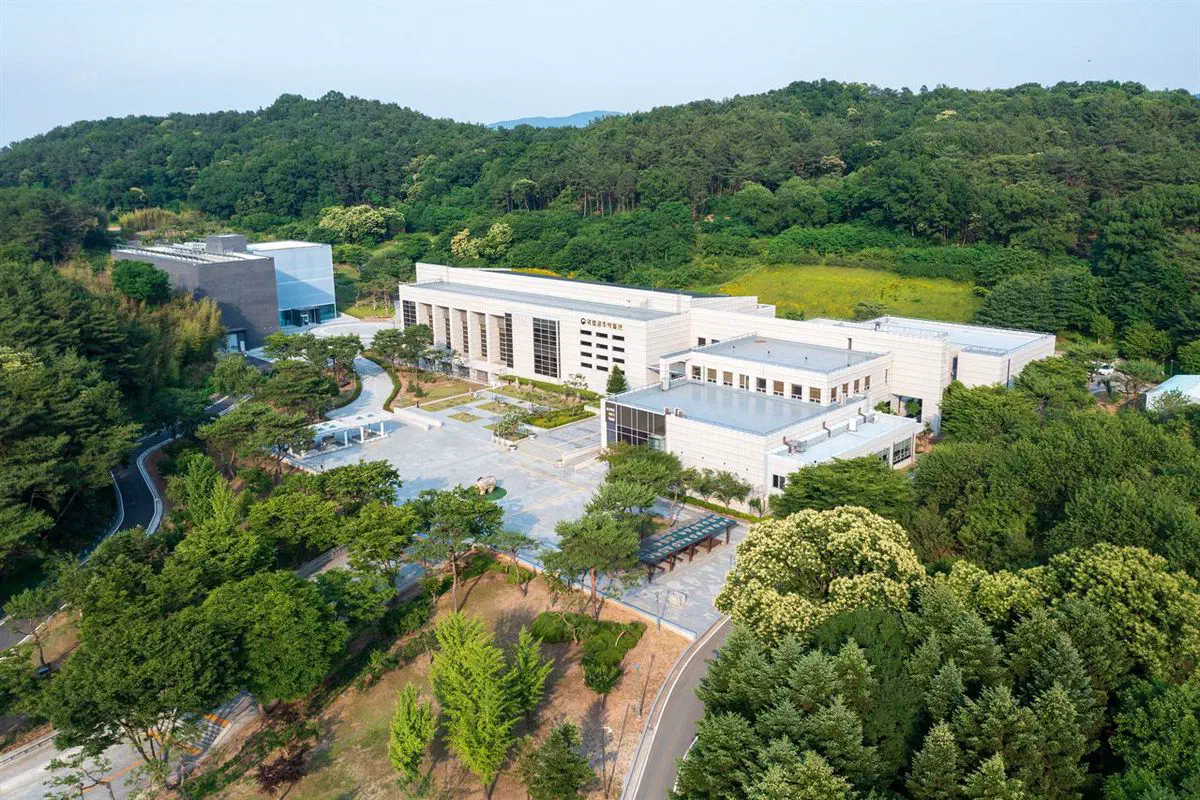
Behind it was an intact Baekje royal tomb, sealed since the sixth century and never robbed. Gongju National Museum holds what came out of it. What happened in the hours after that wall opened is the reason the museum is worth going to, and the reason Korean archaeology still flinches at the story.
Why this tomb mattered more than any other
Baekje left very little. Invaders took its capitals, its records did not survive, and looters had emptied its royal tombs centuries before archaeologists got to them.
This one had not been. And inside were two carved stone epitaph tablets — the king’s measuring 35 by 41.5 centimeters — recording that King Muryeong died on 7 May 523 at the age of 62, and was interred on 12 August 525.
That is the whole reason it is exceptional. Korea has many Three Kingdoms royal tombs. This is the only one that tells you, in writing, who is in it. Scholars attribute every other one by inference.
About 4,600 objects came out of the chamber. Seventeen of them are designated National Treasures.
Twelve hours
What followed is taught in Korea as the worst excavation in the country’s modern history, and the people who ran it agree.
The team went in and finished the entire excavation in twelve hours — eight, counting from the first object lifted. Roughly two hours went on measuring the interior. Removal began at ten at night. The equipment was a few incandescent bulbs run off a generator, and one camera. Objects were boxed and carried out as fast as hands could move, through the night.
Nobody recorded anything in place properly. The position of an object in a burial chamber is evidence — who lay where, in what order, with what — and collecting the objects destroyed almost all of it.
Kim Won-yong, who led the dig and was one of the towering figures of Korean archaeology, later wrote in his memoir that the Muryeong excavation was the greatest shame and error of his life.
The find of the century and the failure of the century were the same night.
- **8 July 1971**
- Drainage workers strike the sealed entrance
- Excavation
- 12 hours total · removal starts 22:00 · generator bulbs and one camera
- Recovered
- About 4,600 objects, 17 of them National Treasures
- The tablets
- Muryeong died 7 May 523, interred 12 August 525 — the only named Three Kingdoms royal tomb
- Verdict
- The excavation director called it the shame of his life
Then it was opened to visitors, and that finished it
The tomb was left open for public viewing for about twenty years.
To make the mound look suitably royal, restorers had rebuilt it larger than it originally was, and the brickwork could not carry the weight. The walls tilted. Temperature differences between inside and outside produced condensation. Algae grew.
By the 1990s a chamber that had stood for fourteen hundred years had become structurally unsafe after twenty-odd years of being looked at. Authorities stopped viewing on 15 July 1997 and settled on permanent closure that 10 November.
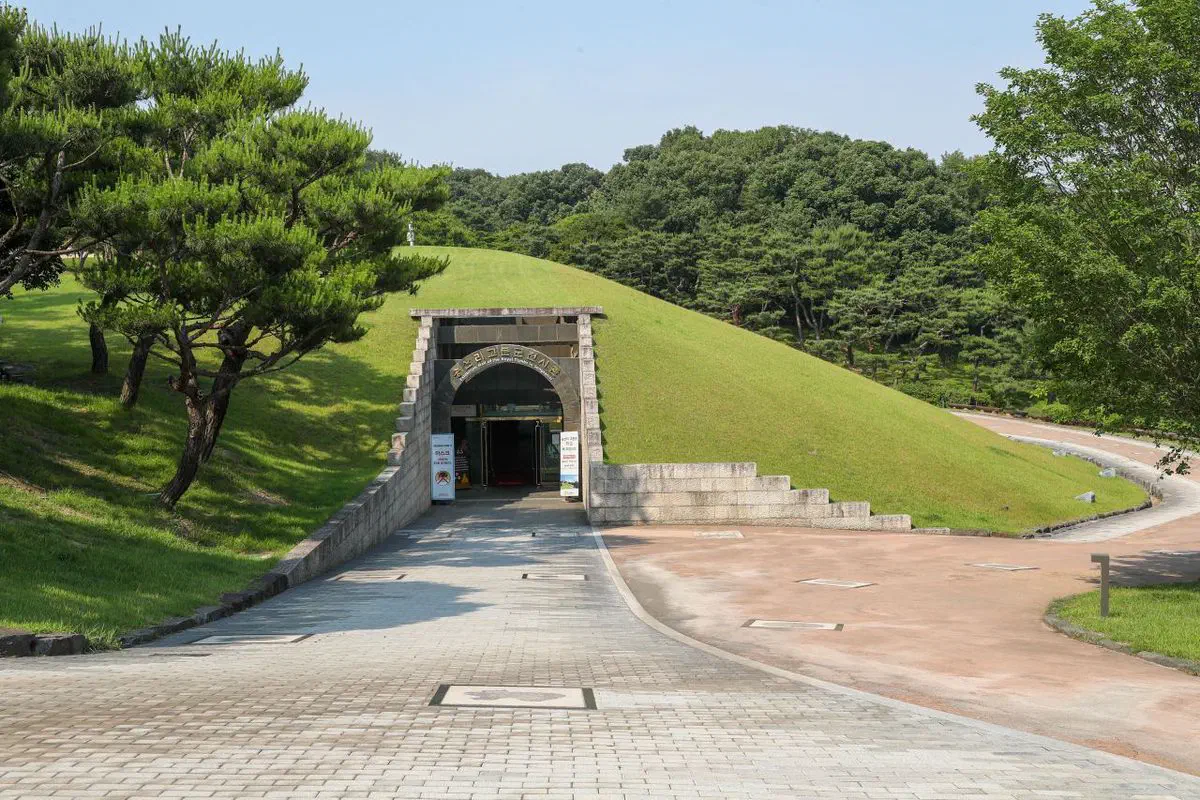
Since 2003 there has been a full-scale replica hall on the site, which is how visitors now see the interior. You cannot go into the tomb. Nobody can.
That building in the photograph is the honest summary of this whole story: a tomb-shaped structure containing a reproduction of a tomb, standing next to the tomb.
What you actually see, and where
The objects are at the museum. The hole they came from sits about two kilometers away at the Royal Tombs of Gongju, formerly the Songsan-ri tomb group. That site is one of the eight components of the Baekje Historic Areas, which UNESCO inscribed on 4 July 2015 as Korea’s twelfth World Heritage property.
Gongju holds two of the eight: the tombs, and Gongsanseong fortress. Buyeo holds four and Iksan two. Gongju came first — it was Ungjin, the capital Baekje fled to in 475 after losing Hanseong, and it held the court until the move to Sabi in 538.
Doing the three cities in order is the single best way to see Baekje, and they sit within about 60 km of each other.
Cost, hours and the Monday problem
Admission to the permanent galleries is free, and the museum runs 09:00 to 18:00, weekends and holidays the same.
It closes Mondays — and when the Monday is a substitute public holiday it closes the Tuesday instead, which is a wrinkle worth reading twice. Ten of Korea’s fourteen national museums close on Mondays; only Seoul, Gyeongju, Jeonju and Gwangju stay open, and they are marked on our museum map.
Getting there
Gongju has no KTX station of its own in town — Gongju Station on the Honam high-speed line is well outside the city — so most visitors arrive by intercity bus, which drops you far closer to the sites. From Seoul that is the simpler option even though it is slower.
Stays in Gongju are thin but not as thin as Buyeo’s — the platform listed 17 properties here against five in Buyeo when we checked on 31 August 2026. If you are doing both Baekje capitals, that settles which one you sleep in. A Korean eSIM covers the local bus timings, since Google Maps will not route you.
In the same trip
Other museums within reach
- Buyeo National Museum — Buyeo, South Chungcheong, about 27 km away.
- Cheongju National Museum — Cheongju, North Chungcheong, about 42 km away.
Festivals near here
These run on their own dates, so check them against yours before you build a route around them.
- Sejong Hangeul Festival — October, about 15 km away.
- Gyeryong Military Culture Festival — October, about 21 km away.
- Daejeon Science Festival — April, about 27 km away.
- Nonsan Strawberry Festival — March, about 30 km away.
- Cheonan World Dance Festival — October, about 39 km away.
Quick answers
Why is the Tomb of King Muryeong so important?
Can you go inside the Tomb of King Muryeong?
Why was the 1971 excavation criticized?
Is Gongju National Museum free?
How many UNESCO sites are in Gongju?
Checked 31 August 2026. The 8 July 1971 discovery during drainage work between the Songsan-ri tombs, the twelve-hour excavation, the 22:00 start to artifact removal, the generator-powered bulbs and single camera, and Kim Won-yong’s later description of the dig as the greatest shame of his life, from Korean press retrospectives and archaeological accounts of the excavation. The epitaph tablets’ dimensions and their record of King Muryeong’s death on 7 May 523 aged 62 and interment on 12 August 525, the roughly 4,600 recovered objects and the seventeen National Treasures, from Korea Heritage Service and National Institute of Korean History records. The suspension of viewing on 15 July 1997, the permanent closure decided on 10 November 1997, the enlarged reconstruction of the mound, the tilting walls, condensation and algae, and the full-scale replica hall built in 2003, from contemporaneous and retrospective Korean press reporting. The Baekje Historic Areas inscription on 4 July 2015 as Korea’s twelfth World Heritage property, and the eight components split two–four–two between Gongju, Buyeo and Iksan, from the Korean National Commission for UNESCO. Hours, the Monday closure and the substitute-holiday rule from the museum’s own visitor information. Hours change — confirm before you travel.