Iksan National Museum: The Pagoda That Broke a Love Story
Last verified: 2026-08-31. Rules and prices change — always confirm on the official site before you travel.
This page contains affiliate links. If you book through them we may earn a commission at no extra cost to you. It never changes what we recommend.
Every Korean schoolchild knows the story. A poor Baekje boy called Seodong wanted Princess Seonhwa of Silla, so he taught the children of her capital a song claiming she was already visiting him at night. The song spread, the court believed it, she was exiled — and he married her. He became King Mu, and the Samguk Yusa says the two of them founded the great temple of Mireuksa.
In 2009, workers taking that temple’s stone pagoda apart found a folded gold plate inside the central pillar. It gives a date — 639 — and it names the person who paid for the temple.
She was not Seonhwa. She was the daughter of Jwapyeong Sataek Jeokdeok, a Baekje noblewoman, and the plate calls her the queen.
What the gold plate actually says
The gold sari reliquary inscription records that the queen, daughter of Sataek Jeokdeok, donated her wealth to raise the temple, and enshrined the relics in the year 639 to pray for the royal house.
That is a primary document, written at the time, found in the place it describes. The Samguk Yusa was compiled roughly six hundred years later. When those two disagree, the plate wins.
It does not prove Seonhwa never existed — Mu may have had more than one queen, and the argument is still live among Korean historians. What it does prove is that the temple’s patron, at the moment the relics went in, was a Baekje aristocrat and not a Silla princess.
The reliquary set from the west pagoda was designated a National Treasure in December 2022, fourteen years after it came out of the ground. It is here, in this museum, along with the rest of what the excavation produced.
Two pagodas, and two completely different ideas about restoration
Go outside and you can see the argument in one glance.
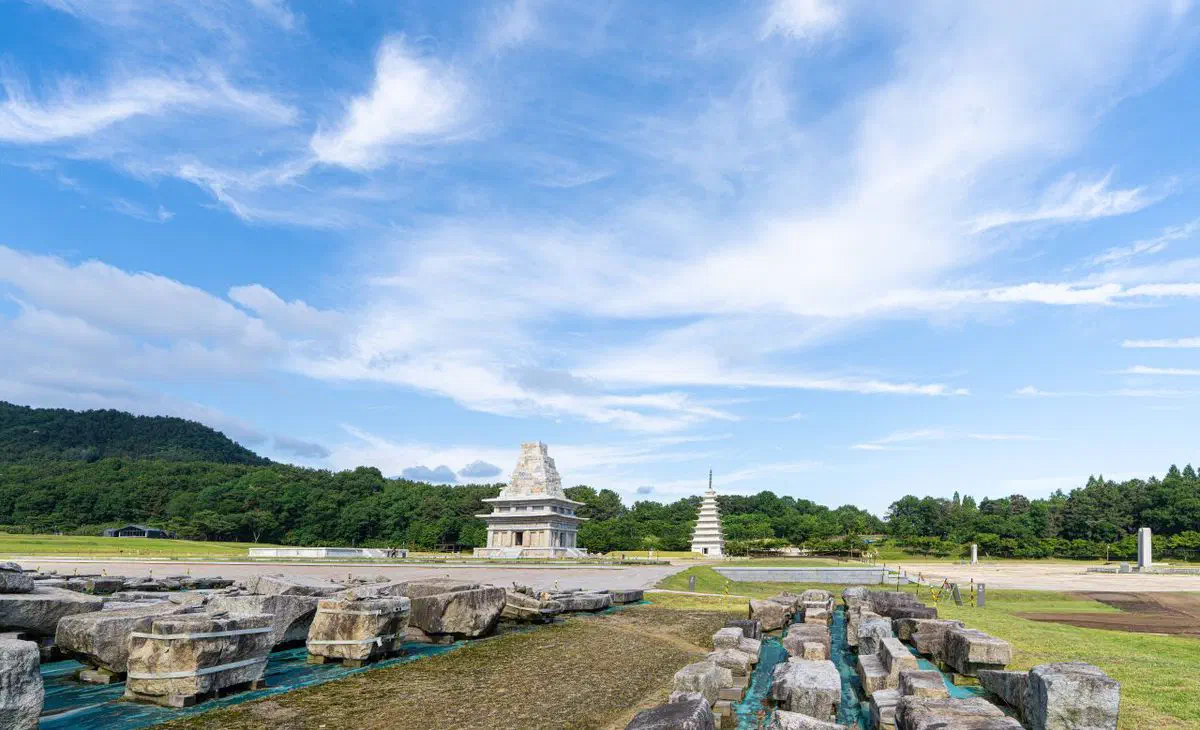
The east pagoda went up in 1993, in about two years — nine stories, a double platform on a 12.5-meter square base, smooth granite, ruler-straight lines. Specialists opposed it at the time. A later head of Korea’s cultural heritage agency said it would be remembered as the worst cultural property restoration of twentieth-century Korea.
The west pagoda is the opposite decision. It is National Treasure No. 11 and the oldest and largest surviving stone pagoda in Korea — probably nine stories once, but only part of it still stood, inside a concrete shell that colonial-era engineers had poured around it.
A 1998 survey found the concrete failing. The heritage committee approved dismantling in 1999, and the work finished on 30 April 2019 — twenty years. The result stands 14.5 meters tall and 12.5 meters wide: 1,627 stone members, about 1,830 tons, 81% original material.
And it stops where the evidence stopped. Nobody guessed the missing stories back into existence.
- East pagoda
- Rebuilt 1993, about 2 years, full nine stories, largely new granite
- West pagoda
- Dismantled 1999, finished 30 April 2019 — 20 years, 81% original stone
- Height
- 14.5 m · 12.5 m wide · 1,627 members · ~1,830 tons
- The difference
- One was rebuilt to what someone imagined. One was rebuilt to what survived.
The museum made itself disappear
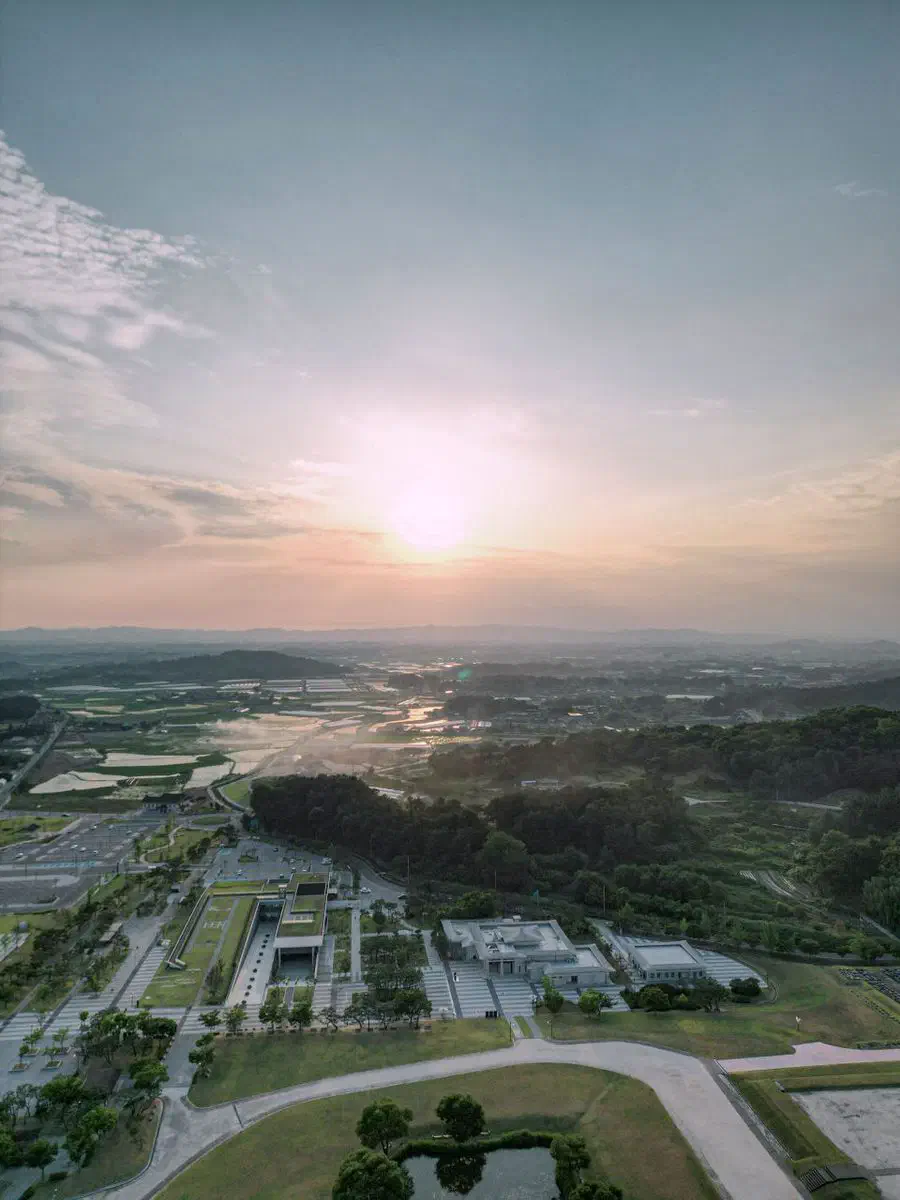
The building follows the same instinct.
Iksan National Museum opened on 10 January 2020, with about 7,500 m² of floor area and 2,100 m² of galleries — and it is built two floors below ground with one above, deliberately, so it does not stand in front of the temple site. The architects called the strategy the invisible museum.
The Mireuksa Site Relics Hall came first, in 1997. It became a national institution in 2015, after UNESCO inscribed the Baekje Historic Areas, and took the name Iksan National Museum in 2019.
So the pattern holds across three decisions in one place: publish the inscription that spoils the story, rebuild only what you can prove, and bury the museum so the ruin keeps the view.
Where this sits in Baekje
Iksan holds two of the eight components of the Baekje Historic Areas — the Mireuksa site and the Wanggung-ri palace site. That makes it the last of three cities:
- Gongju — Ungjin, the capital from 475
- Buyeo — Sabi, from 538 until Baekje fell in 660
- Iksan — the late Sabi period, and where King Mu built at scale
Wanggung-ri’s five-story pagoda produced its own reliquary set — National Treasure No. 123, found in 1965 when the pagoda was dismantled for repair, and including the Diamond Sutra engraved on nineteen sheets of pure gold, folded and bound with gold cord. For fifty-five years Jeonju National Museum held it. It came back to Iksan when this museum opened in January 2020.
The three cities sit within about 60 km of each other, and doing them in order is the best way to see Baekje that exists.
Cost, hours and getting there
Admission to the permanent galleries is free. It runs 09:00 to 18:00, Tuesday to Sunday, with last entry at 17:30.
It closes Mondays, like ten of Korea’s fourteen national museums — only Seoul, Gyeongju, Jeonju and Gwangju stay open, and they are marked on our museum map.
Iksan is a KTX stop on the Honam line, which makes it the easiest of the three Baekje cities to reach from Seoul. The museum is out at Geumma-myeon rather than in town, so budget a bus or taxi from the station.
Stays in Iksan benefit from the KTX connection, though not by much. Checking all three Baekje cities on 31 August 2026 gave Gongju 17 properties, Iksan 8, and Buyeo 5. If you are sleeping once and driving between them, sleep in Gongju. A Korean eSIM covers the local buses, since Google Maps will not route you.
In the same trip
Other museums within reach
- Jeonju National Museum — Jeonju, North Jeolla, about 24 km away.
- National Institute of Ecology (Ecorium) — Janghang, Seocheon, South Chungcheong, about 28 km away. Sea and ecology rather than history.
- Buyeo National Museum — Buyeo, South Chungcheong, about 31 km away.
Festivals near here
These run on their own dates, so check them against yours before you build a route around them.
- Nonsan Strawberry Festival — March, about 22 km away.
- Hansan Ramie Fabric Cultural Festival — June, about 22 km away.
- Jeonju Hanji Culture Festival — October, about 25 km away.
- Jeonju Bibimbap Festival — October, about 25 km away.
- Gimje Horizon Festival — October, about 33 km away.
Quick answers
What did the 2009 Mireuksa discovery change?
Is the Seodong and Seonhwa story true?
Why do the two pagodas at Mireuksa look so different?
Is Iksan National Museum free?
Which Baekje sites are in Iksan?
Checked 31 August 2026. The gold sari reliquary inscription’s 2009 discovery in the west pagoda’s central pillar, its date of 639, its naming of the queen as the daughter of Jwapyeong Sataek Jeokdeok, and its conflict with the Samguk Yusa account, from Korea Heritage Service records and the Digital Iksan Cultural Encyclopedia; the reliquary set’s designation as a National Treasure in December 2022 from Korea Heritage Service announcements. The west pagoda’s status as National Treasure No. 11 and as Korea’s oldest and largest surviving stone pagoda, the 1998 structural survey, the 1999 decision to dismantle, the completion on 30 April 2019, and the figures of 14.5 m, 12.5 m, 1,627 members, about 1,830 tons and 81% original material, from Korean government and heritage-research sources. The east pagoda’s 1993 reconstruction, its nine stories on a 12.5 m square base, and the criticism of it as the worst restoration of twentieth-century Korea from Korean press reporting — that judgment is a quoted opinion, attributed, not our own. The museum’s 10 January 2020 opening, its roughly 7,500 m² floor area and 2,100 m² of galleries, its two-below-one-above structure, the “invisible museum” design strategy, and the 1997 relics hall that preceded it from the National Museum of Korea’s announcement and the museum’s own materials. Hours change — confirm before you travel.