Jinju National Museum: The Lanterns Were a Weapon
Last verified: 2026-09-01. Rules and prices change — always confirm on the official site before you travel.
This page contains affiliate links. If you book through them we may earn a commission at no extra cost to you. It never changes what we recommend.
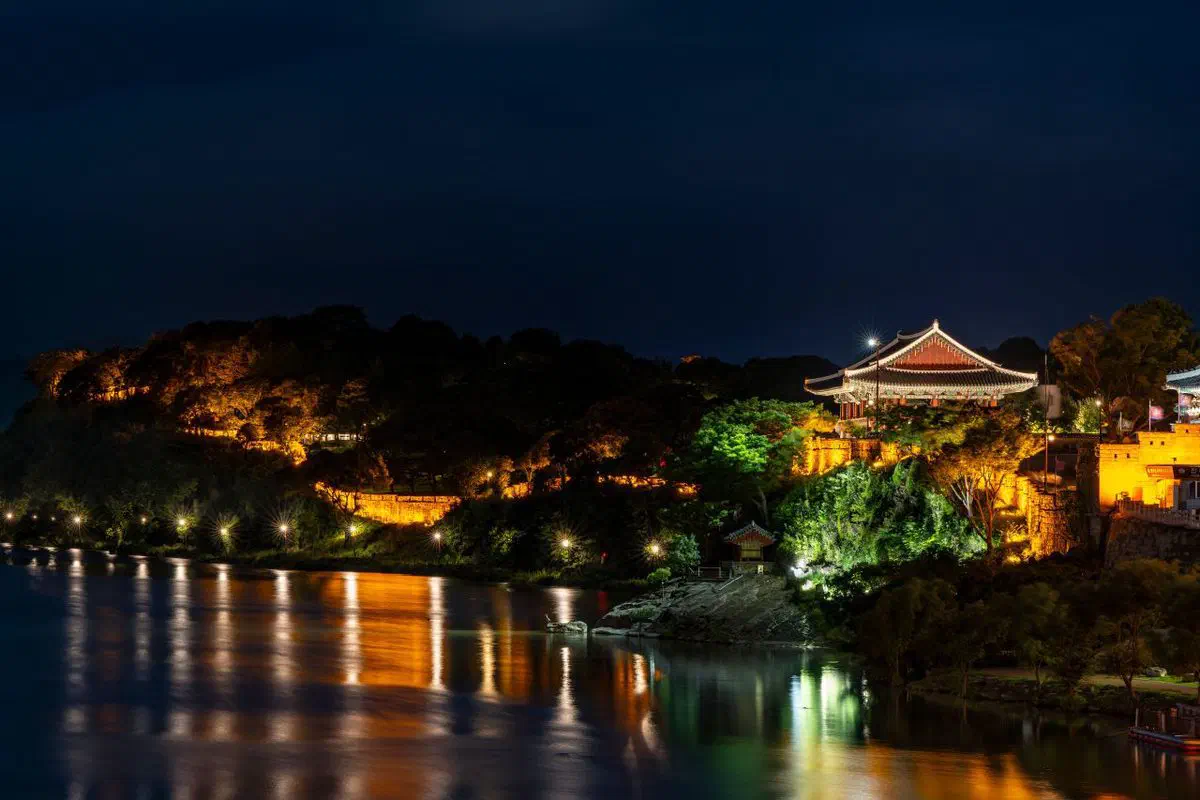
Every autumn Jinju floats thousands of lanterns down the Nam River, and it is one of the more photographed things in Korea.
The lanterns are not decorative in origin. In 1592, the defenders inside Jinjuseong put them on the water at night for two reasons: to make it impossible for the Japanese to cross the river unseen, and to signal to families outside the walls that the people inside were still alive.
Jinju National Museum is inside that fortress.
The siege that held, and the one that did not
The Imjin War ran from 1592 to 1598, and Jinju is where two of its most consequential engagements happened on the same ground, a few months apart.
October 1592. A Japanese army — put at twenty to thirty thousand depending on the account — surrounded the fortress. Inside were the Jinju magistrate Kim Si-min with about 3,800 regulars, and the townspeople. Outside, Gwak Jae-u’s irregular forces harassed the Japanese rear. The fortress held, the Japanese withdrew, and the battle is counted as one of the three great Korean victories of the war alongside Hansando and Haengju.
June 1593. The Japanese came back with more than ninety thousand. The fortress fell after a siege of about a week. Korean accounts put the dead — soldiers and civilians together — at seventy thousand.
- **1592, first siege**
- ~3,800 defenders and the townspeople hold against 20,000–30,000. Held.
- **1593, second siege**
- Over 90,000 Japanese troops. About a week. Fell.
- The dead
- Put at 70,000, soldiers and civilians together
- The lanterns
- A tactic first — to deny a night crossing, and to send word out
Nongae, a Jinju gisaeng, is said to have embraced a Japanese commander at Chokseongnu after the fall and taken him with her into the river. That account comes down as folk tradition rather than documented record, and Korean sources label it that way. It is worth knowing as a story the city tells about itself, not as something the museum can prove.
The building was designed for a different subject
Here is the part that makes this museum unusual.
It opened on 2 November 1984 as a museum of Gaya culture, handling archaeology for western South Gyeongsang. The building is by Kim Swoo-geun, the most celebrated Korean architect of the twentieth century, and it is one of his signature works: a traditional wooden pagoda worked out in stone, its roofs stacking in tiers.
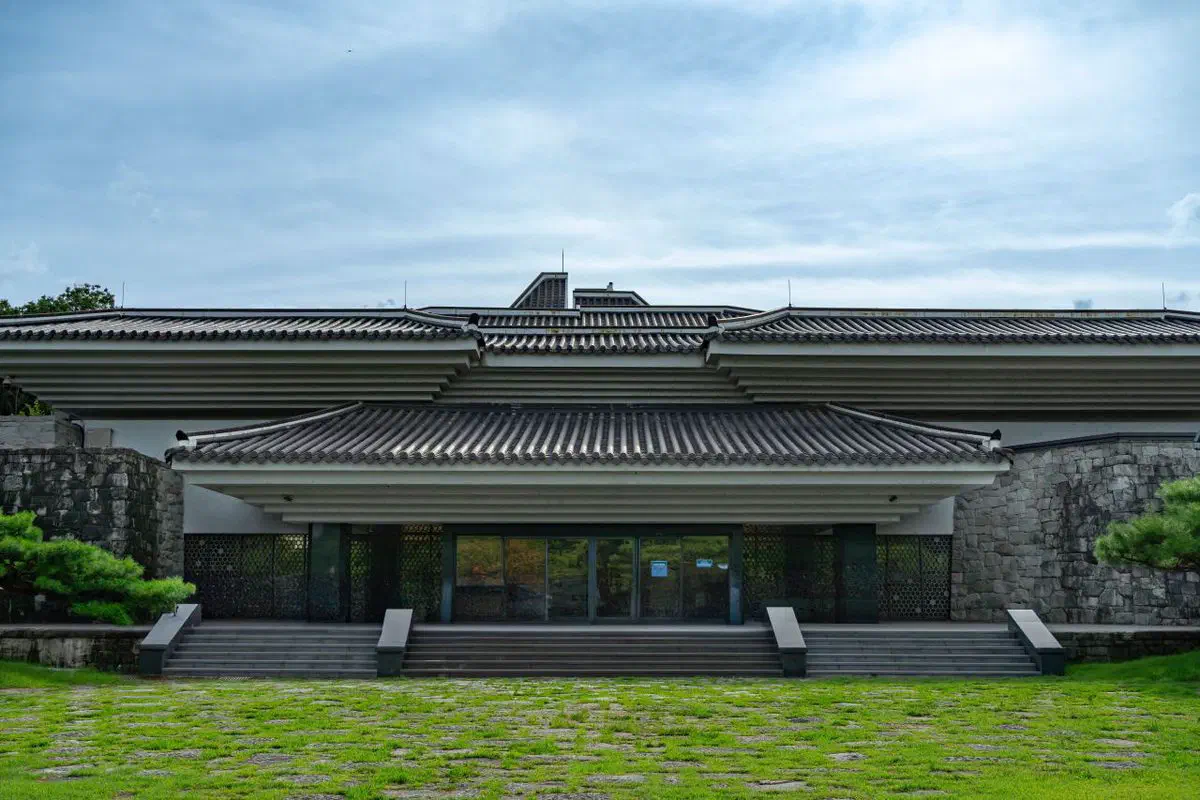
In January 1998 the museum changed subject entirely. It became a history museum about the Imjin War — not because the collection demanded it, but because of where the building stands. Korea decided that a national museum sitting inside the war’s greatest battleground should be about the war.
Two more rooms followed: the Duam Gallery in November 2001, for the collection donated by Kim Yong-du (1922–2003), a Korean resident of Japan from nearby Sacheon; and a regional history gallery in December 2008.
A building shaped like a pagoda, built for one kingdom, given over to a war, and holding a collection returned from Japan. It is a strange institution and the strangeness is the interesting part.
If you can time it, come in October
The Jinju Namgang Yudeung Festival runs 3–18 October 2026, and it takes place at Jinjuseong and on the Nam River — which means the museum sits inside the festival grounds rather than near them.
That is the one week a year when the fortress, the river and the lanterns can be read as a single thing, which is what they were.
If your dates do not line up, the fortress is worth walking after dark anyway — Chokseongnu is lit, and the walls above the river are the actual subject of everything inside the museum.
Cost, hours and the Monday problem
Admission to the permanent galleries is free. Hours are 09:00 to 18:00.
It closes Mondays, 1 January, Seollal and Chuseok. That is the majority pattern: ten of Korea’s fourteen national museums close on Mondays, and only Seoul, Gyeongju, Jeonju and Gwangju do not. They are marked on our museum map.
Getting there
Jinju is on the Gyeongjeon line and has an intercity bus terminal; from Busan it is a straightforward bus ride, and it also works as a stop between Busan and the south coast. The fortress is central — the museum is inside the walls, about 300 meters from the main gate, and the city’s central market is under a kilometer away.
Stays in Jinju are thinner than the city’s size suggests — 17 properties listed when we checked on 1 September 2026. A two-week festival does not fit inside that, so if your dates are in October, book now rather than later. A Korean eSIM covers the local buses, since Google Maps will not route you.
In the same trip
Festivals near here
These run on their own dates, so check them against yours before you build a route around them.
- Jinju Namgang Yudeung Festival — October, about 1 km away.
- Gwangyang Maehwa Festival — March, about 35 km away.
- Sancheong Medicinal Herb Festival — October, about 36 km away.
- Hadong Wild Tea Cultural Festival — May, about 39 km away.
Quick answers
Why is the Jinju lantern festival held on the Nam River?
What happened at the sieges of Jinju?
Why is Jinju National Museum about the Imjin War?
Is the story of Nongae true?
Is Jinju National Museum free, and when is it closed?
Checked 1 September 2026. The museum’s opening on 2 November 1984 as a museum of Gaya culture, the building as a representative work of the architect Kim Swoo-geun rendering a traditional wooden pagoda in stone, the change of subject to the Imjin War in January 1998 on the strength of its location inside Jinjuseong, the Duam Gallery opened on 19 November 2001 for Kim Yong-du’s donated collection, and the regional history gallery added in December 2008, from the museum’s own pages and Korean press coverage. The 1592 siege — Kim Si-min, roughly 3,800 regulars, the townspeople, Gwak Jae-u’s irregulars outside, and the Japanese force put variously at twenty or thirty thousand — and the 1593 siege with over ninety thousand Japanese troops and around seventy thousand dead, from the National Institute of Korean History and the Encyclopedia of Korean Culture. The figures for both sieges vary between accounts and we have given the ranges rather than picking single numbers. The lanterns’ origin as a defensive tactic and a means of signalling to families outside the walls, and their later use as a memorial rite, from the festival organizer’s own account of the tradition and Jinju city cultural records. The Nongae account is folk tradition, not documented record, and Korean sources say so. Festival dates from our festival data, sourced from the Korea Tourism Organization. Hours change — confirm before you travel.