Busan's National Maritime Museum: The Divers Are Still There
Last verified: 2026-08-31. Rules and prices change — always confirm on the official site before you travel.
This page contains affiliate links. If you book through them we may earn a commission at no extra cost to you. It never changes what we recommend.
Korea’s National Maritime Museum is the only one of its kind in the country, holds around ten thousand objects across four floors, and costs nothing to enter.
It is also two kilometers from women who are still diving for a living, in a neighborhood where people have been pulling food out of this same water for about eight thousand years.
The neighborhood is the exhibit
The museum sits in Dongsam-dong, on the island of Yeongdo. Three things have happened in that one dong, and they are the same thing three times.
About 8,000 years ago, Neolithic people began piling up the shells of what they ate here. The heap kept growing for four thousand years. The Dongsam-dong Shell Midden was designated a National Historic Site on 26 July 1979, and it turned out to be more than a rubbish tip — jar burials, dwellings and hearths came out of it too. A small exhibition hall opened on the site in 2002.
At the end of the nineteenth century, Jeju haenyeo crossed to the mainland to dive, and Yeongdo was their first foothold. From the 1960s they began settling rather than coming seasonally, and they sold what they caught — sea urchin especially — into the Japanese market.
Today there are around 119 haenyeo of Jeju descent working on Yeongdo, second and third generation included. That is the largest group in Busan. The district is building a Haenyeo Culture Exhibition Hall at Jungni Beach, about 1.8 km from the museum, on the shore where the first generation started.
If you have read our piece on the Jeju Haenyeo Museum, this is the other end of that story. Jeju has the museum; Yeongdo has where they went.
What is inside
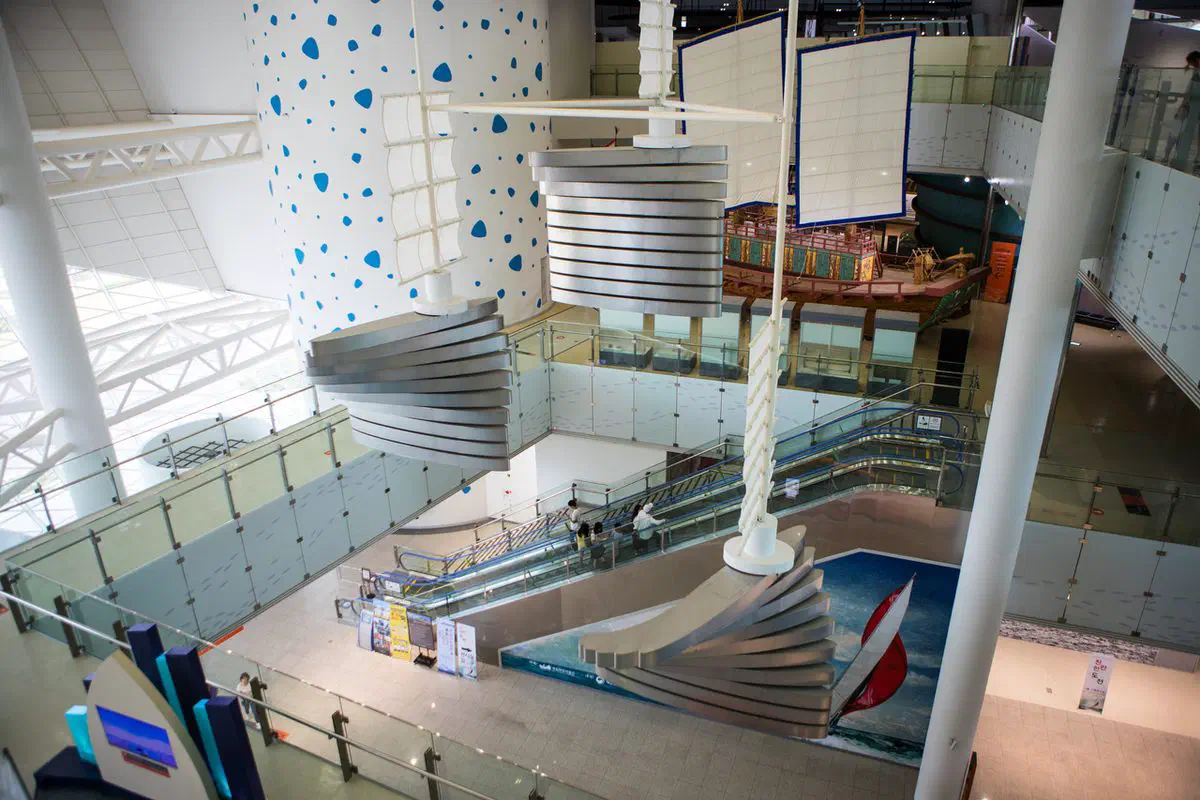
The museum opened on 9 July 2012 on a 45,386 m² site, with about 25,870 m² of building running from one basement level to the fourth floor.
- The ship
- A half-scale Joseon Tongsinsa vessel — the ships that carried Korean diplomatic missions to Japan — rigged across the central atrium
- Collection
- Around 10,000 objects on maritime history, science and industry
- Aquarium
- A tunnel tank and touch pool inside the museum, which is not a thing most museums have
- Library
- A maritime library, Tue–Sun 09:00–17:30
- Children's museum
- By reservation only
The aquarium is the detail worth flagging in advance. It is genuinely part of the museum rather than a separate attraction, and it is the reason a visit here works for families in a way that most national museums do not.
Free, except for two things
The permanent exhibitions are free. What is not free is the 4D theater and any paid special exhibition running at the time. Neither is compulsory, so a full visit here can cost nothing at all.
That puts it in the same bracket as the national history museums on our museum map, and unlike the paid halls on the sea and ecology side — the whale museum charges ₩2,000, and the Ecorium ₩5,000.
The closing pattern is the aquarium-and-park one, though: Mondays, moving to the next weekday when the Monday is a public holiday.
The weekend hours are better than the weekday hours, which is unusual enough to plan around. Tuesday to Friday it runs 09:00–18:00 with last entry at 17:30. On Saturdays, Sundays and public holidays it runs to 19:00, with last entry at 18:30 — a full extra hour.
- Admission
- Free for permanent exhibitions · 4D theater and special exhibitions charged
- Tue–Fri
- 09:00–18:00, last entry 17:30
- Sat / Sun / holidays
- 09:00–19:00, last entry 18:30
- Closed
- Mondays (next weekday if the Monday is a holiday)
Getting there: Yeongdo has no subway
This is the practical thing to know before you set out. Yeongdo is the only one of Busan’s sixteen districts with no metro station. The island is joined to the mainland by bridges, and the metro stops on the other side of them.
The route is Busan Metro Line 1 to Nampo Station, Exit 6, then bus 66 or 186, which takes around thirty minutes. Budget that transfer rather than assuming a station.
Our two days in Busan covers the city’s fare zones, which catch people out on longer rides. A Korean eSIM pays for itself on a bus-dependent trip like this one — both Korean map apps track the 66 live, and Google Maps will not route you.
What else is on the island
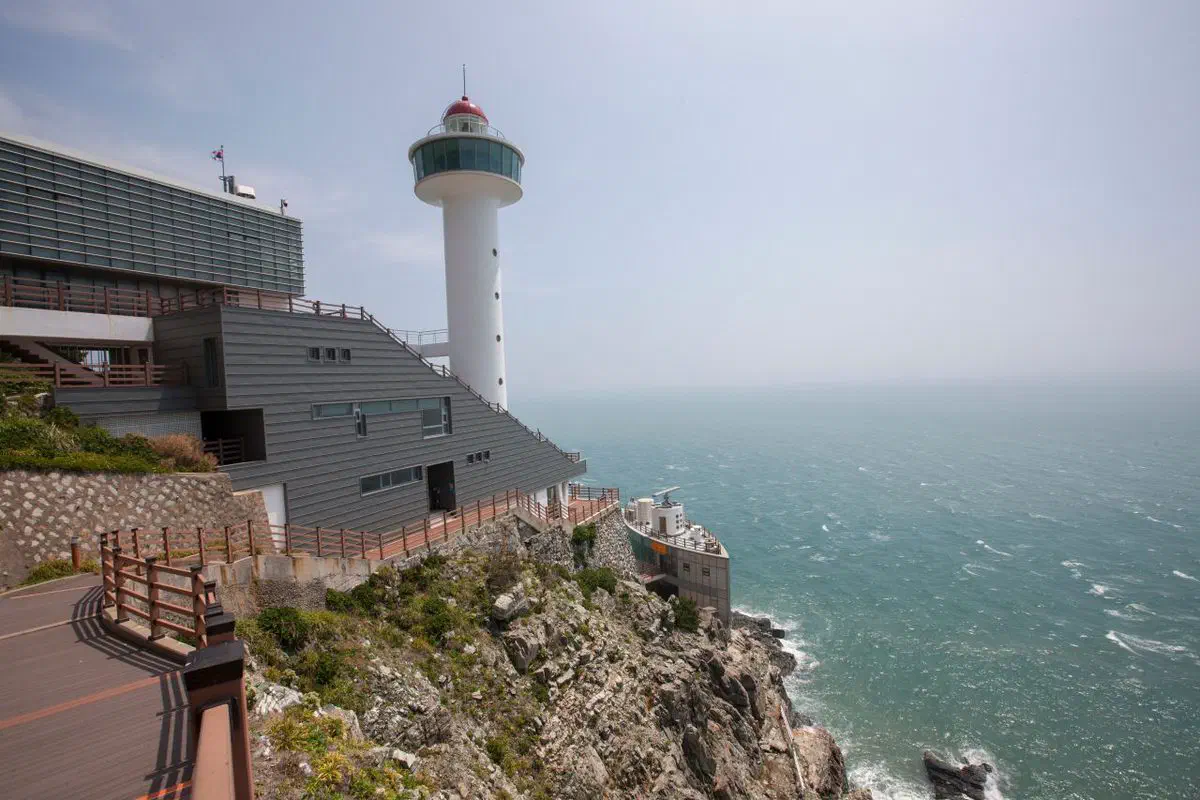
Taejongdae is about 2.3 km away, and its cliffed coast is part of the Busan National Geopark — the cliff walk is the reason most people come to Yeongdo at all. Pairing it with the museum makes the trip across the bridge worth the transfer in a way that either does alone.
Stays in Busan mostly cluster around Haeundae, which is the other end of the city from here — check the fare zones before assuming the ride is cheap.
In the same trip
Other museums within reach
- Gimhae National Museum — Gimhae, South Gyeongsang, about 26 km away.
Festivals near here
These run on their own dates, so check them against yours before you build a route around them.
- Gwangalli Eobang Festival — June, about 9 km away.
- Haeundae Sand Festival — May, about 12 km away.
- Busan International Rock Festival — October, about 15 km away.
- Dongnae Eupseong History Festival — October, about 15 km away.
- Gimhae Buncheong Ceramics Festival — November, about 36 km away.
The coast from here
- The Namparang Trail — Oryukdo, Nam-gu, Busan, about 4 km away. The trail itself runs 1,470 km along the south coast, so it likely passes closer than this.
Filmed near here
- Busan K-Pop Locations — Gamcheon, Saha-gu, Busan, about 7 km away.
Quick answers
Is the National Maritime Museum in Busan free?
How do you get to the National Maritime Museum?
What are the National Maritime Museum's opening hours?
Does the National Maritime Museum have an aquarium?
Are there still haenyeo in Busan?
Checked 31 August 2026. Opening hours, the Monday closure, free permanent admission, the paid 4D theater, the reservation-only children’s museum and the maritime library hours from the museum’s own visitor information. The 9 July 2012 opening, the 45,386 m² site and 25,870 m² building area, the B1–4F layout, the roughly 10,000 objects and the half-scale Joseon Tongsinsa ship from the museum’s materials and Korean reference sources. The Dongsam-dong Shell Midden’s designation as a National Historic Site on 26 July 1979, its formation between roughly 8,000 and 4,000 years ago, and the jar burials, dwellings and hearths found in it from Korea Heritage Service records; the on-site exhibition hall opened 24 April 2002. The late-nineteenth-century arrival of Jeju haenyeo on Yeongdo, settlement from the 1960s, the sea urchin export trade, the figure of 119 divers of Jeju descent and the Haenyeo Culture Exhibition Hall planned at Jungni Beach from Korean regional press reporting — the diver count is theirs, not one we can verify. Yeongdo’s lack of a metro station and the Nampo Station bus connection from Busan transport and tourism information. Hours and prices change — confirm before you travel.