Sihwa Tidal Power Observatory: A Dead Lake's Second Act
Last verified: 2026-09-03. Rules and prices change — always confirm on the official site before you travel.
This page contains affiliate links. If you book through them we may earn a commission at no extra cost to you. It never changes what we recommend.
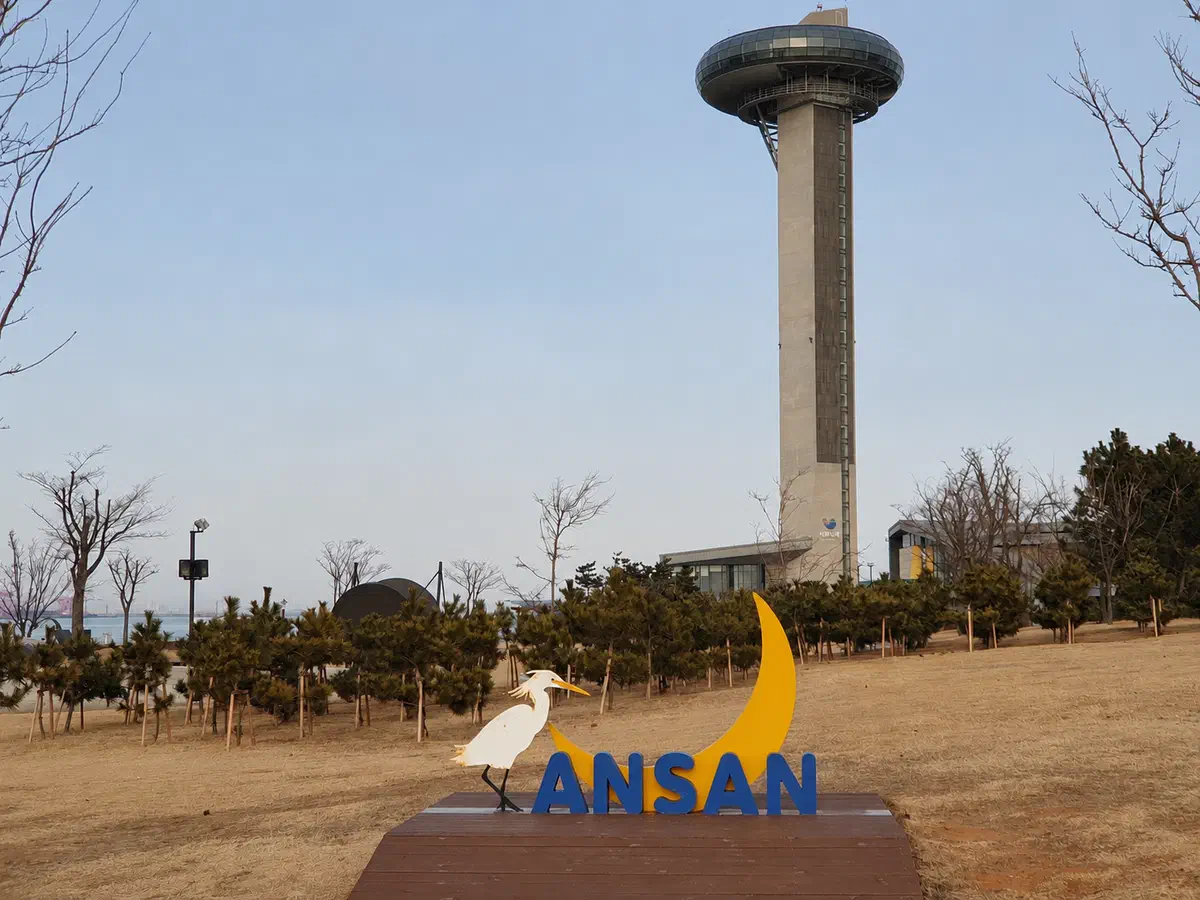
There is no collection here, no glass case, no wall of artifacts. The Sihwa Tidal Power Moon Observatory is a 75-meter tower standing on top of a working power plant, and the building is the whole exhibit — you are climbing a machine that is still running underneath you.
The lake the tidal plant was built to fix
Sihwa Lake died within a few years of being sealed off. Engineers finished the seawall closing it from the sea in 1994. The water rotted almost immediately. Chemical oxygen demand, the standard pollution measure, jumped from 2–3 ppm before the wall to about 17 ppm by 1997, as industry and unfinished sewage systems drained straight into a lake with no outlet. Korean reporting from the period called it, literally, the “Lake of Death.”
The fix, in the end, was to let the sea back in. Engineers reopened the sluice gates for seawater exchange from 1997 to 1999, and officials formally reclassified the lake from freshwater to seawater in 2001. Construction on a tidal power plant began in 2004 — designed to use the same tidal exchange that was keeping the lake alive, and generate electricity from it at the same time.
The record the plant still holds
The Sihwa Lake Tidal Power Station entered commercial operation in 2011. Its capacity — 254 megawatts — made it the largest tidal power station in the world, overtaking France’s La Rance plant (240 MW), which had held the record since the 1960s.
- Capacity
- 254 MW — world’s largest tidal power station by capacity
- Commercial operation
- Since 2011
- Water quality since
- COD back down to around 2 ppm, near pre-seawall levels
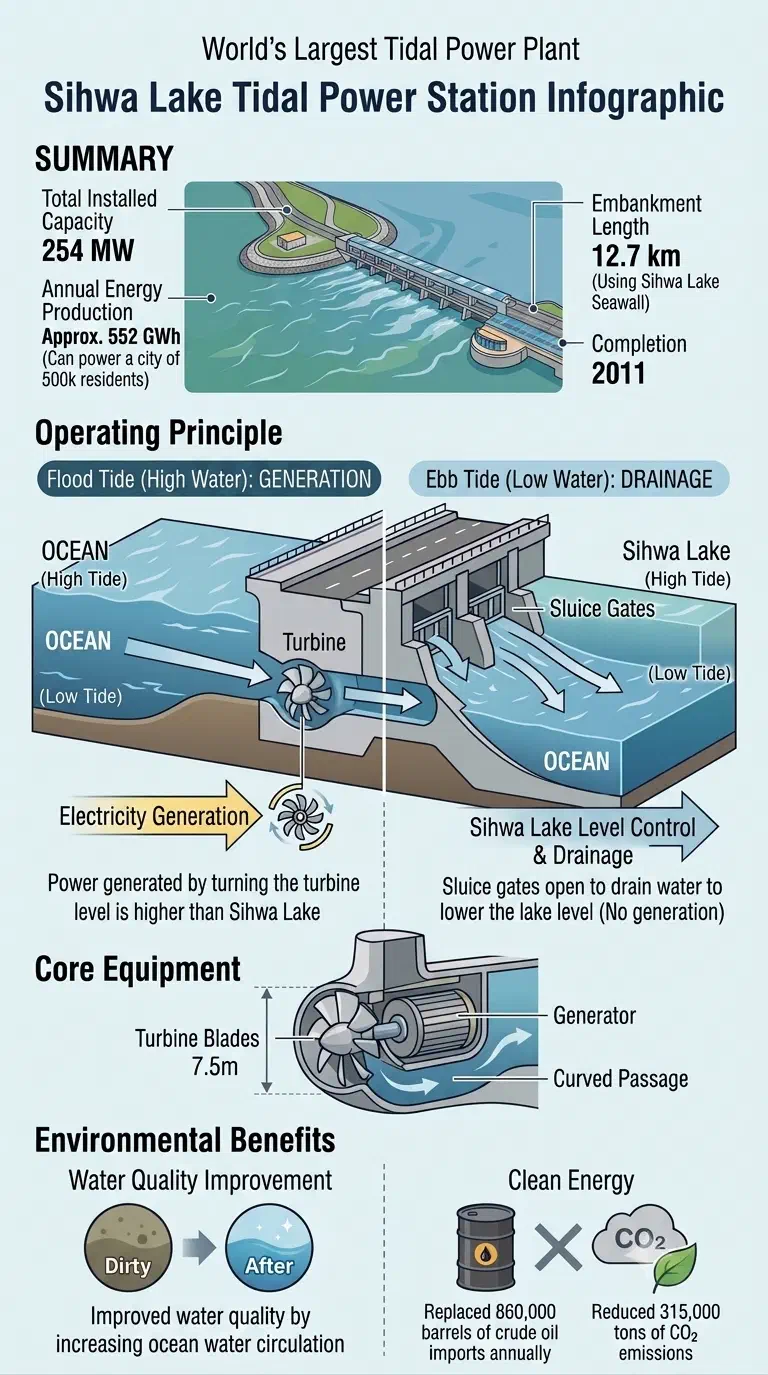
The mechanism is simple in principle. The tidal difference between the sea and the lake behind the seawall drives turbines as water moves through sluice gates — the same idea as a hydroelectric dam using a river’s drop in height. What makes Sihwa unusual is the loop it closes: the “problem” driving the design was keeping water moving through a lake that had died from stagnation, and that same motion is what the plant turns into power. Water quality has recovered to close to what it was before the seawall went up.
Standing on top of it
Workers finished the observatory itself in June 2014, a glass-domed tower built directly onto the plant’s own structure. From the deck, the view runs across Sihwa Lake on one side and the open West Sea on the other — the two bodies of water the turbines below are constantly exchanging. On a clear day the causeway road stretches out beneath you in both directions, the seawall and the water it separates laid out at once in a way no ground-level photo of the plant can show.
A separate Sihwa Nare Tidal Culture Center, in the same complex, carries its own exhibition halls. It is worth calling ahead about if the mechanics of the plant interest you beyond the view — hours and programs there run separately from the observatory itself, and the two buildings are easy to conflate from the parking area below.
Getting there
Daebudo has no subway or rail connection — a car is genuinely the practical way to reach the observatory, across the causeway road that doubles as the seawall itself. From central Ansan it is roughly 40–50 minutes by car; public transit means a bus into Daebudo followed by a local connection, considerably slower.
A Korean eSIM is worth having before you set out — live directions matter more here than in the city, and Naver Map handles addresses like this one better than Google Maps does. Our eSIM comparison covers which to buy.
In the same trip
Festivals near here
These run on their own dates, so check them against yours before you build a route around them.
- Incheon Pentaport Rock Festival — July, about 11 km away.
- Hwaseong Boating Festival — May, about 15 km away.
- Siheung Gaetgol Festival — September, about 18 km away.
- Bupyeong Pungmul Festival — October, about 23 km away.
- Bucheon International Comics Festival — September, about 25 km away.
The coast from here
- Muuido and the West Coast Beaches — Muuido, Jung-gu, Incheon, about 25 km away.
Quick answers
Is the Sihwa tidal power plant really the world's largest?
Why was Sihwa Lake called the "Lake of Death"?
Did the tidal power plant actually clean up the lake?
Is the Sihwa observatory free to visit?
Checked 3 September 2026. Observatory hours, admission and address from K-water’s own facility page. The 1994 seawall completion, the collapse in water quality and its “Lake of Death” reputation, the 1997–1999 seawater exchange restoration, the 2001 reclassification to a seawater lake, and the recovery of chemical oxygen demand to around 2 ppm from Korean-language environmental reporting on Sihwa Lake’s history. The tidal plant’s 2004 construction start, 2011 commercial operation, 254 MW capacity and its record ahead of France’s 240 MW La Rance plant from Korean energy-industry reporting and K-water’s own project materials. The observatory’s June 2014 opening from contemporaneous travel reporting. The lead photograph is our own, taken on a visit to the site — this section otherwise relies on KOGL and Wikimedia Commons images, and neither archive had a usable photograph of this particular building. Hours and programs change — confirm before you travel.