Joseon Royal Tombs: The UNESCO Site in the Middle of Gangnam
Last verified: 2026-09-18. Rules and prices change — always confirm on the official site before you travel.
This page contains affiliate links. If you book through them we may earn a commission at no extra cost to you. It never changes what we recommend.
Gangnam’s skyline stops at a tree line, and on the other side of it are two Joseon kings. Seolleung and Jeongneung — a walled, forested tomb park five minutes from Seolleung Station — sit in the middle of Seoul’s most modern business district, close enough that the office towers show in the same frame as a six-hundred-year-old burial mound. It is one of the more genuinely surprising things a first-time visitor can see in Seoul, and most guides to Gangnam never mention it exists.
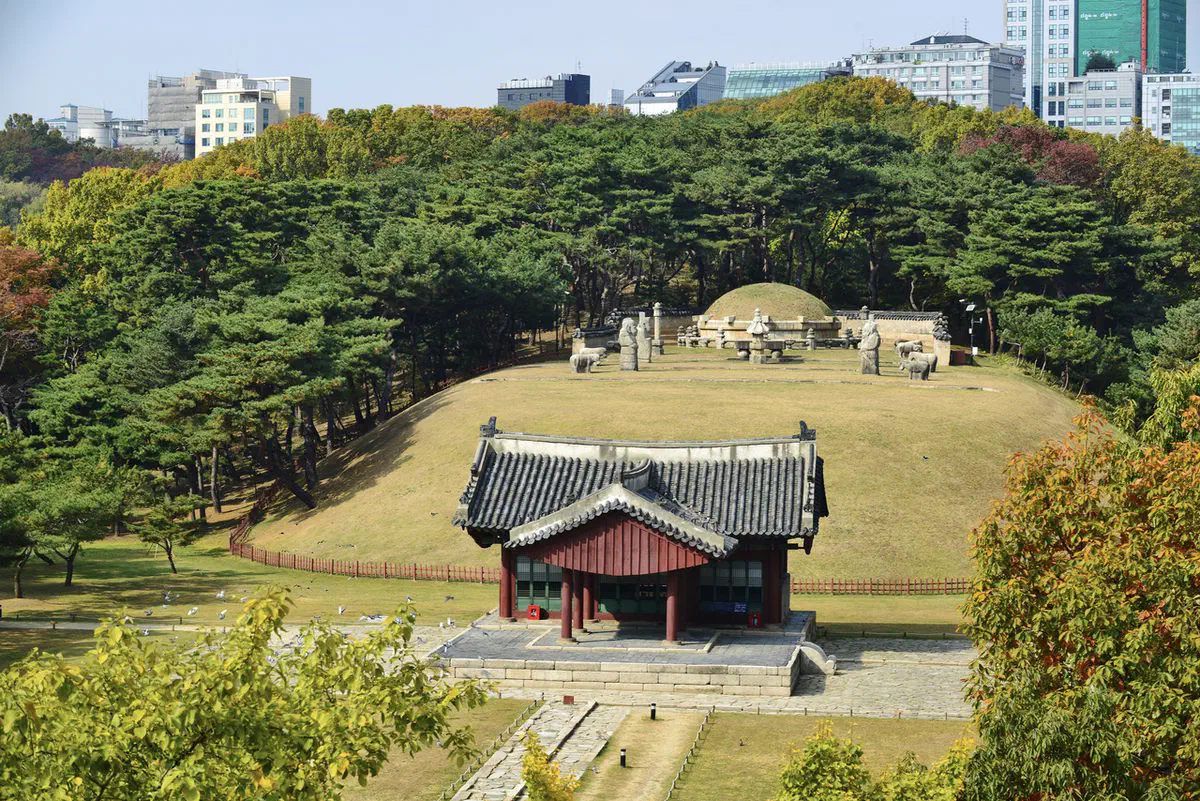
This is one small piece of a much larger listing. Our Jongmyo Jerye article covers the ancestral rite performed for these same kings and queens at their shrine in central Seoul — this page covers where their bodies actually rest.
What the UNESCO listing actually covers
Royal Tombs of the Joseon Dynasty was inscribed by UNESCO in 2009: 40 tombs across 18 locations, built between 1408 and 1966, holding the kings, queens and posthumously-honored monarchs of the 500-year Joseon dynasty (1392–1910). Four burial sites are notably absent from the listing — two because they sit in North Korea (Queen Sinui’s tomb and King Jeongjong’s tomb), and two because the rulers buried there, Yeonsangun and Gwanghaegun, were deposed in palace coups and stripped of their royal titles. Under Korean heritage law their graves are classified as myo (commoner or prince-grade graves) rather than neung (royal tombs), so they don’t qualify regardless of UNESCO’s own process.
Inside Seoul, no day trip required
Most of the 18 sites sit outside Seoul, but four tomb clusters are inside the city itself:
- Seolleung and Jeongneung
- Gangnam-gu · Seolleung Station (Line 2/Bundang Line), Exit 10 · Kings Seongjong and Jungjong
- Taereung and Gangneung
- Nowon-gu · has a 1.8 km forest trail and an on-site tomb museum · Queen Munjeong and King Myeongjong
- Heonilleung
- Seocho-gu, Naegok-dong · King Taejong and King Sunjo, connected by a 600 m trail
- Uireung
- Seongbuk-gu, Seokgwan-dong · King Gyeongjong, buried front-to-back with his queen rather than side by side
Seolleung and Jeongneung is the one worth prioritizing if you only see one — it’s the most central, the easiest to reach, and the contrast with the surrounding skyline is the whole point of going. Admission is ₩1,000 for adults, and hours run 06:00–21:00 March through October (shorter in winter).
Outside the city, Donggureung in Guri holds nine royal tombs on a single site — the largest of all 18 locations — reachable from Gangbyeon or Gwangnaru stations plus a short bus ride. Seooreung in Goyang holds five more.
How a tomb is laid out — and why you can’t walk up to the mound
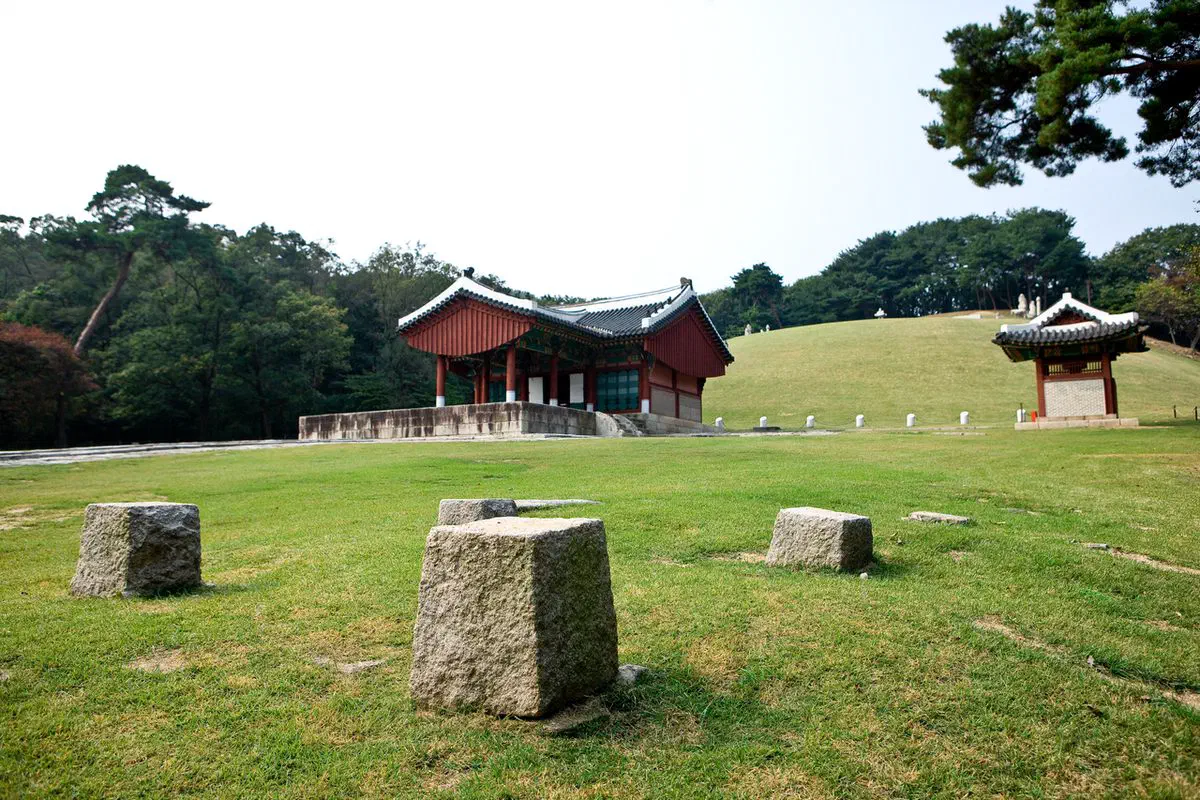
Every Joseon royal tomb follows roughly the same plan. Two raised stone paths lead toward a jeongjagak, a T-shaped shrine hall where memorial rites were performed — the higher path, the sindo, was reserved for the spirit of the deceased, and etiquette guides still suggest visitors keep to the lower eodo rather than walk directly on it. Behind the shrine hall sits the grass-covered burial mound itself, flanked by carved stone officials — munseokin (civil officials holding scepters) and museokin (military officials, hands on their swords) — along with stone animals standing guard.
At most sites, the mound is fenced and viewed from a set distance rather than approached directly — a tighter restriction than Gyeongju’s Silla-era tumuli at Daereungwon, where visitors walk on paths that pass much closer to the mounds themselves, and can enter one excavated tomb, Cheonmachong, directly. One detail underlines how deliberate that restriction is: for Korea’s annual Joseon Royal Tombs Festival, held 17–25 October 2026 across 12 sites this year, the normally closed burial-mound areas at some tombs are opened to visitors specifically for the festival period — the rest of the year, that closer view is the exception, not the rule.
What’s new in 2026
Korea Heritage Service has been running public programming at the four in-Seoul tomb clusters plus Donggureung’s Seoul-adjacent sibling since May 2026 — free guided tours, performances and workshops, though standard admission still applies. Seolleung and Jeongneung are also slated to get AI-generated English audio guides later in 2026. Separately, royal tombs — like palaces — have historically offered free admission only on the last Wednesday of each month; Korea Heritage Service expanded that to every Wednesday starting 27 May 2026.
A guided day out in Seoul is one way to build a tomb visit into a longer day if you’d rather not plan the transit yourself — though Seolleung and Jeongneung specifically needs nothing more than a subway ride.
Are Joseon royal tombs the same as the mounds in Gyeongju?
Which Joseon royal tomb is easiest to visit from central Seoul?
Can you walk up to a Joseon royal tomb's burial mound?
Why are some Joseon rulers' graves not part of the UNESCO listing?
Checked 18 September 2026. UNESCO listing scope (40 tombs, 18 sites, 2009 inscription) from the UNESCO World Heritage Centre listing. The four excluded burial sites and the myo/neung legal distinction from Korea Heritage Service’s own explainer and the Joseon Royal Tombs Festival’s official background page. Seolleung/Jeongneung and Taereung/Gangneung access, hours and admission from Seoul Metropolitan Government. Donggureung and Seooreung details from VisitKorea. 2026 public programming, AI audio guides and the Wednesday free-admission expansion from The Korea Times. 2026 Joseon Royal Tombs Festival dates and site count from Korean-language news coverage published 14 September 2026. Tomb layout terminology cross- checked against a National Palace Museum of Korea feature. Some details — exact subway access for Heonilleung and Uireung, and current UNESCO monitoring findings — could not be confirmed against UNESCO’s own documents during research; treat site-specific transit as a starting point and confirm locally.