Korean Shows You Can Enjoy Without Korean
Last verified: 2026-08-12. Rules and prices change — always confirm on the official site before you travel.
This page contains affiliate links. If you book through them we may earn a commission at no extra cost to you. It never changes what we recommend.
Finding Korean shows without Korean is harder than it sounds. Seoul has thousands of performances running at any moment and almost none will work for you — musicals and plays run in Korean, without surtitles, priced as if you will follow the jokes.
Three categories do work, and one of them costs nothing.
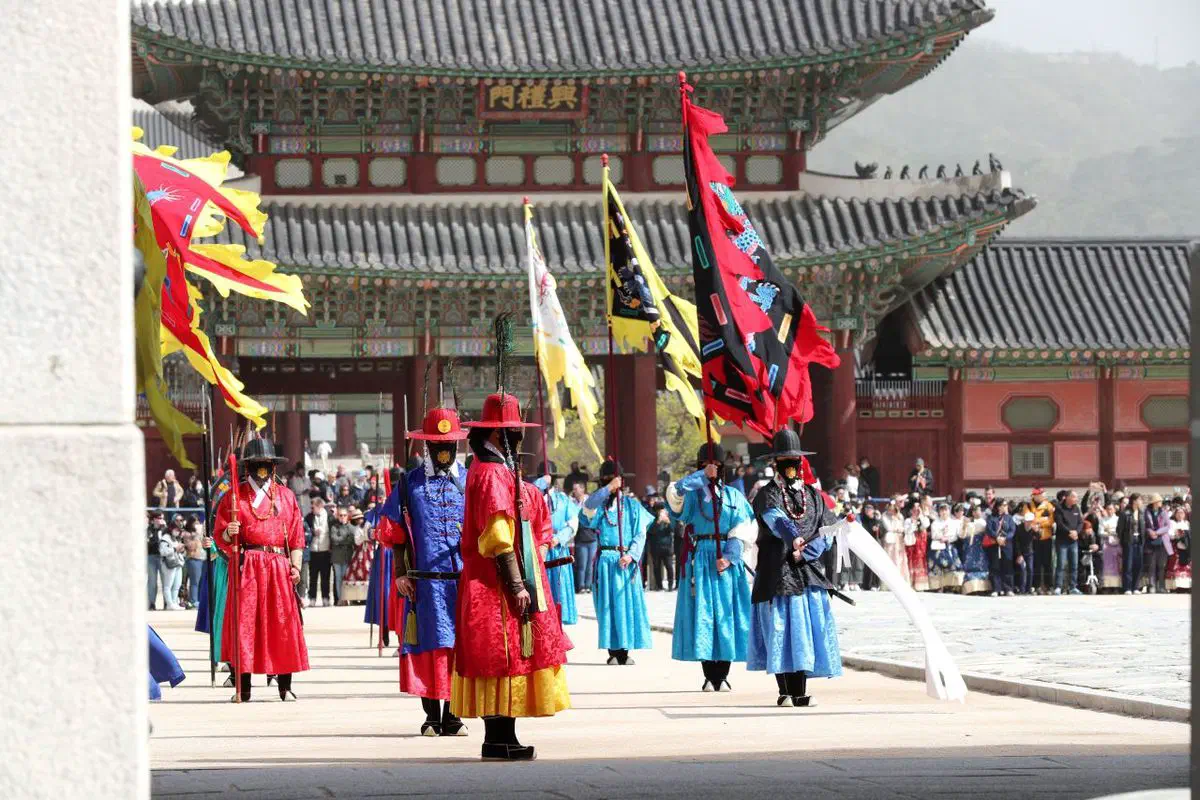
Korean shows without Korean: the free ones first
Gyeongbokgung runs a full daily program of ceremonial performance, and none of it needs a ticket beyond palace admission — some of it needs nothing at all, since the gate ceremonies happen outside the ticket line.
- 09:35 · 13:35
- Guard training display — 15 minutes
- 10:00 · 14:00
- Changing of the guard — 20 minutes, the big one
- 11:00 · 13:00
- Gwanghwamun gate watch — 10 minutes
- 15:00–16:00
- Patrol ceremony — weekends and holidays, March–May and September–November only
Four separate ceremonies, none of them requiring a word of Korean. Uniforms, drums, flags, formations. If you arrive at Gyeongbokgung for the 10:15 English tour of Changdeokgung you have already missed the 10:00 changing — plan the order.
Culture Day is now every Wednesday
Free or reduced entry across museums, palaces and performance venues. It used to be the last Wednesday of the month; since 1 April 2026 it runs every Wednesday, and by May covered around 1,576 venues.
That is four times the chance of catching something free, and it is the single most useful scheduling fact in this article. The rules page tracks it.
The palace festival, twice a year
Gungjung Munhwa Chukjeon takes over Gyeongbokgung, Changdeokgung, Deoksugung, Changgyeonggung and Jongmyo with performances and night openings. The autumn 2026 edition runs 7–11 October.
The ticketed night programs that run alongside it — the Moonlight Tour and the Starlight Night Tour — are a separate booking problem entirely, and our palace night tours guide covers the part that catches foreign visitors out.
Traditional music and dance
This is the category most visitors miss, and it is where language matters least — you are watching musicians and dancers, not following a plot.
The National Gugak Center runs Saturday Masterpieces every Saturday at 15:00, drawing on all four of its companies: court music, folk music, dance and contemporary composition. Seats are ₩20,000–30,000.
The interesting part is who the audience is. Foreign visitors now make up close to 40% of it, and the 2026 program was rebuilt with that in mind. The lobby has a photo area with court dress and instruments.
The same center runs English tours of its Gugak Museum and a Culture Day gugak program.
Non-verbal shows
The commercial answer, and the reason these exist at all: they were built for audiences who do not speak Korean.
NANTA is the one everybody names — four cooks, Korean samulnori percussion, a kitchen, no dialogue. It has run in Myeongdong since 2009 on an open run, which is its own recommendation.
- Running time
- 90 minutes
- Myeongdong
- Mon–Fri 17:00 · 20:00 — Sat 14:00 · 17:00 · 20:00 — Sun and holidays 14:00 · 17:00
- Face value
- ₩50,000 A · ₩60,000 S · ₩70,000 VIP
- Age
- Suitable from 12 months
Nobody pays face value. It sells discounted through the booking platforms — NANTA on Klook is the usual route, and there is a Hongdae theater as well as Myeongdong.
THE PAINTERS is the other long-running non-verbal show, built around live painting. Check current dates before planning around it — the season structure changes and we could not confirm the current run.
What to skip
Being blunt saves you money.
Musicals and plays. Seoul has a serious musical industry and it plays to Korean audiences. Surtitles are the exception, not the rule.
Bookings through Korean ticketing sites, unless you read Korean. Interpark and Yes24 dominate, both are Korean-first, and neither is built for a visitor with a foreign card and no Korean address.
K-pop concerts, unless you already have a plan. Tickets go through fan-club presales and Korean-only queues, and the resale market is a different kind of problem.
Fitting it into a day
The palace ceremonies anchor everything else, because they are fixed, free and in the middle of the city.
A workable Wednesday, taking advantage of the new Culture Day: guard training at 09:35, changing of the guard at 10:00, palace and its English tour, then whatever the venues have opened up for the day.
A workable Saturday: changing of the guard at 10:00, the hanok districts or a craft workshop in the middle of the day, Saturday Masterpieces at 15:00.
Venue addresses are the usual problem — the suffix tells you how hard the last hundred meters will be — so Naver Map and a Korean eSIM before you start. Our comparison covers which.
Quick answers
What free performances run at Gyeongbokgung palace?
What is NANTA, and do I need to speak Korean to enjoy it?
Can I watch traditional Korean music and dance without understanding Korean?
What is Culture Day in Korea, and when is it?
Checked 12 August 2026. Gyeongbokgung ceremony times and durations from the Korea Heritage Agency’s program listing. Saturday Masterpieces timing, pricing, company line-up and the foreign-audience share from National Gugak Center announcements and its published schedule. NANTA running time, performance times and face-value pricing from the show’s own listings. Culture Day’s move to every Wednesday from 1 April 2026 from Ministry of Culture, Sports and Tourism announcements. Festival dates and programs change every season — confirm before building a day around any of this.