How to Ride the Seoul Subway: The Complete Guide
Last verified: 2026-09-05. Rules and prices change — always confirm on the official site before you travel.
This page contains affiliate links. If you book through them we may earn a commission at no extra cost to you. It never changes what we recommend.
The Seoul subway is one of the easiest systems in the world to ride once you know four or five things nobody explains on the platform. None of them are hard. All of them are the kind of thing a local learned once, years ago, and forgot they ever had to learn.
What the colors mean
Every line has a color and a number, and both appear everywhere — on maps, on platform signs, on the trains themselves. You do not need to memorize this; you need to know it exists, so a colored line on a map means something specific rather than just decoration.
Fares and how to pay
A single ride starts at ₩1,550 with a T-money card, covering the first 10 km — every 5 km after that adds about ₩100. Paying with a disposable single-journey ticket costs slightly more and adds a step: buy it from a vending machine, pay the fare plus a ₩500 deposit, tap in and out with it like a card, then feed it into a deposit refund machine near the exit gates to get your ₩500 back. Skip that step and the deposit is simply gone.
For anyone staying more than a day or two, a T-money card is the better default — ₩4,000 to buy (unrefunded), sold at convenience stores and station machines, and it works on every subway line, every city bus, and most taxis nationwide, not just in Seoul.
Topping up a T-money card
Recharging is cash-only at a convenience store: hand your card to the cashier at any GS25, CU or 7-Eleven and say “chungjeon haejuseyo” (충전해주세요) — “please recharge this.” Minimum ₩1,000, maximum ₩90,000 per transaction, in ₩1,000 steps, and there is no fee — every won you hand over lands on the card. Station vending machines do the same job and take cards as well as cash, if you would rather avoid the Korean.
Finding your way inside the station
Exits are numbered, usually starting from 1 near the station’s main entrance and running roughly clockwise. Every sign, every map app direction and every address near a subway stop refers to these numbers (“Exit 3,” “Exit 6”) rather than compass directions — worth noting the number before you go looking for a landmark on the surface.
Platforms mark where the doors will open. Painted numbers and lines on the platform floor show where each car will stop and where its doors will be, so the queue lines you see people standing in are not random — they are lining up for a specific door on a specific car.
Restrooms are not always past the gate. Whether a station’s toilet sits before or after the ticket gates varies station to station, and even differs between lines at the same transfer station. If yours is on the wrong side, Seoul Metro’s own rule (in effect since July 2023) lets you tap out, use it, and tap back in within 10 minutes at the same station and same line with no extra fare charged.
Hours, rush hour, and the last train
Most lines start around 5:30 AM and the last trains reach their final stop around midnight — but this varies by line, station and direction, so check the exact time for your specific trip rather than assuming a fixed cutoff. Missing makcha (막차), the last train, is a common and entirely avoidable way to end a night early; both Naver Map and Kakao Map show it on the same screen as the next arrival.
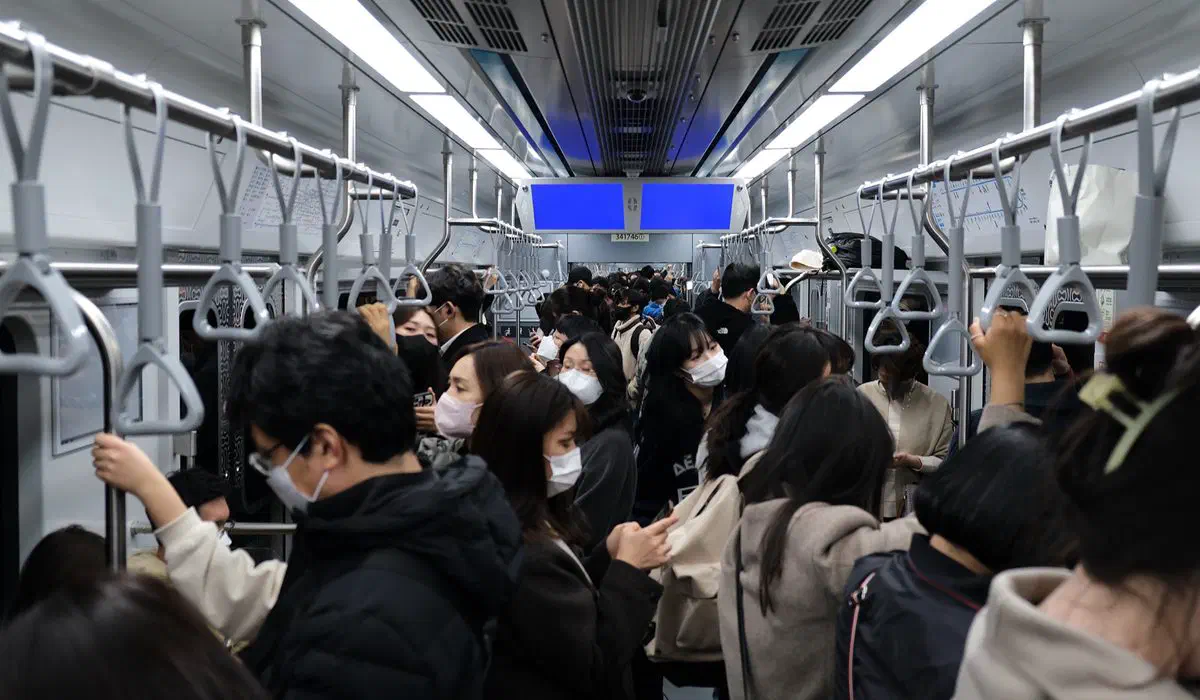
Morning rush runs roughly 7:30–9:00 AM and evening rush 5:30–8:00 PM on weekdays, worst on Line 2 through Gangnam and Sadang, Line 9’s express trains, and Line 1 through Seoul Station. Monday mornings and Friday evenings are the two times to actively plan around if you can.
Transfers
Switching between subway lines inside the paid zone, without exiting through a gate, costs nothing extra regardless of how many lines you use. Switching between subway and bus, or bus and bus, works the same way through Korea’s integrated fare system — free within 30 minutes of tapping out (extended to 60 minutes between 9 PM and 7 AM), for up to five transfers.
The catch is that you must tap your card on the way out, not just the way in — skip that and you lose the transfer discount and the system treats your next ride as a fresh trip. Since March 2026 this rule got sharper on the Seoul subway specifically; our piece on the tap-out change covers exactly what changed and what it costs you if you miss it.
Etiquette
Seats near the ends of each car are priority seating (노약자석) for elderly, pregnant, and disabled passengers — sitting there as an able-bodied rider under sixty draws real disapproval, even in an empty car. Phones stay on silent or on vibrate. Eating and drinking inside the train is frowned on outside a sealed bottle of water. And despite years of “stand on both sides” campaigns on escalators, the habit of standing right and walking left has not gone away — follow it unless the platform’s own signage says otherwise.
If you lose something
Seoul Metro runs five lost-and-found centers, split by line pair, open weekdays 9 AM to 6 PM only — closed weekends and public holidays:
- Lines 1–2
- Seoul City Hall Station · 02-6110-1122
- Lines 3–4
- Chungmuro Station · 02-6110-3344
- Lines 5–8
- Wangsimni Station · 02-6311-6765 / 6768
- Lines 6–7
- Taereung Station · 02-6311-6766 / 6767
- Line 9
- Sports Complex Station · 02-2656-0930
You can also report a loss by phone through 182, or through Seoul Metro’s general line, 1577-1234. The centers hold items by the date and approximate time you lost them, not by station alone, so having both ready speeds things up considerably.
Luggage
Standard coin lockers run roughly ₩2,000–5,000 depending on size, in ₩1,000 steps for shorter windows at some stations, and only operate during subway hours — you cannot retrieve a bag after about midnight. Large suitcases, 27 inches and up, often will not fit the standard compartments. Seoul Metro’s newer T-Locker network covers over 270 stations with more than 5,500 lockers system-wide, letting you check availability and in many stations reserve a locker in advance through the Seoul Metro app rather than hoping one is free when you arrive.
The short version
- Base fare
- ₩1,550 with T-money for the first 10 km, about ₩100 per 5 km after
- T-money card
- ₩4,000, unrefunded, works on bus and most taxis too
- Top up
- Cash only, GS25 / CU / 7-Eleven, ₩1,000–90,000 per transaction
- Operating hours
- Roughly 5:30 AM to midnight — varies by line and station
- Rush hour
- 7:30–9:00 AM and 5:30–8:00 PM weekdays; Line 2, Line 9 express, Line 1 worst
- Free transfers
- Within 30 min (60 min, 9 PM–7 AM), up to 5 — must tap out to keep it
- Lost something
- 182, or the line-pair center above — weekdays only, 9 AM–6 PM
Getting there
A Korean eSIM makes every part of this easier — Naver and Kakao Map both show live train position, which car to stand at for your transfer, and the last-train cutoff on the same screen. Arriving from the airport, our Incheon arrival guide covers where a T-money card fits into that first hour. The same card carries straight over to buses and Ttareungyi for the parts of a trip the subway doesn’t reach, and to intercity buses once you’re heading out of Seoul entirely — a taxi is the one mode that doesn’t share the same fare system.
Quick answers
How much is a Seoul subway ticket?
What time does the Seoul subway stop running?
Do I need to tap out when I leave the subway?
Where do I recharge a T-money card?
Checked 5 September 2026. Base fare, T-money card price and the distance-based add-on from Seoul Metro’s own fare page and current 2026 fare-comparison guides, reflecting the June 2025 fare increase from ₩1,400 to ₩1,550. Convenience-store recharge limits and the cash-only rule are consistent across current T-money guides. Line colors from Seoul Metro’s own signage and route maps. The July 2023 free re-entry rule for out-of-gate restrooms, and the March 2026 tap-out change, are covered in more detail in our tap-out piece. Lost-and-found center locations and phone numbers from Seoul Metro’s own lost-and-found information page. Rush-hour times and the most crowded lines from current Seoul Metro congestion reporting. Coin locker pricing and the T-Locker station count from current Seoul Metro locker guides. Fares, hours and locker availability change — confirm on Seoul Metro’s own site before you travel.