KPop Demon Hunters: The Real Seoul Behind It
Last verified: 2026-09-06. Rules and prices change — always confirm on the official site before you travel.
This page contains affiliate links. If you book through them we may earn a commission at no extra cost to you. It never changes what we recommend.
KPop Demon Hunters is animated, not live-action — so, strictly, nothing in it has a “filming location.” What it has instead is a Seoul built almost entirely from real, identifiable landmarks, redrawn rather than filmed. Seoul’s own tourism board has leaned into this directly, building an official trail around what it calls the film’s 소울스팟 (“soul spots”) — real places that inspired the animated ones. None of them need the show’s popularity to stay worth a visit.
Animation, not filming — worth saying plainly
Every location below is a motif, not a set a camera stood inside. Seoul’s tourism board describes each one as what “inspired” a scene, and Korean fan communities who compared the film frame-by-frame against reality found the same pattern every time: the animators resize buildings, compress distances, and in at least one scene, show a landmark from an angle where you’d never actually see it. None of that makes the real places less worth visiting — it just means you’re not standing on a film set. You’re standing at the real thing an artist looked at.
N Seoul Tower — the Saja Boys’ finale stage, minus the stadium
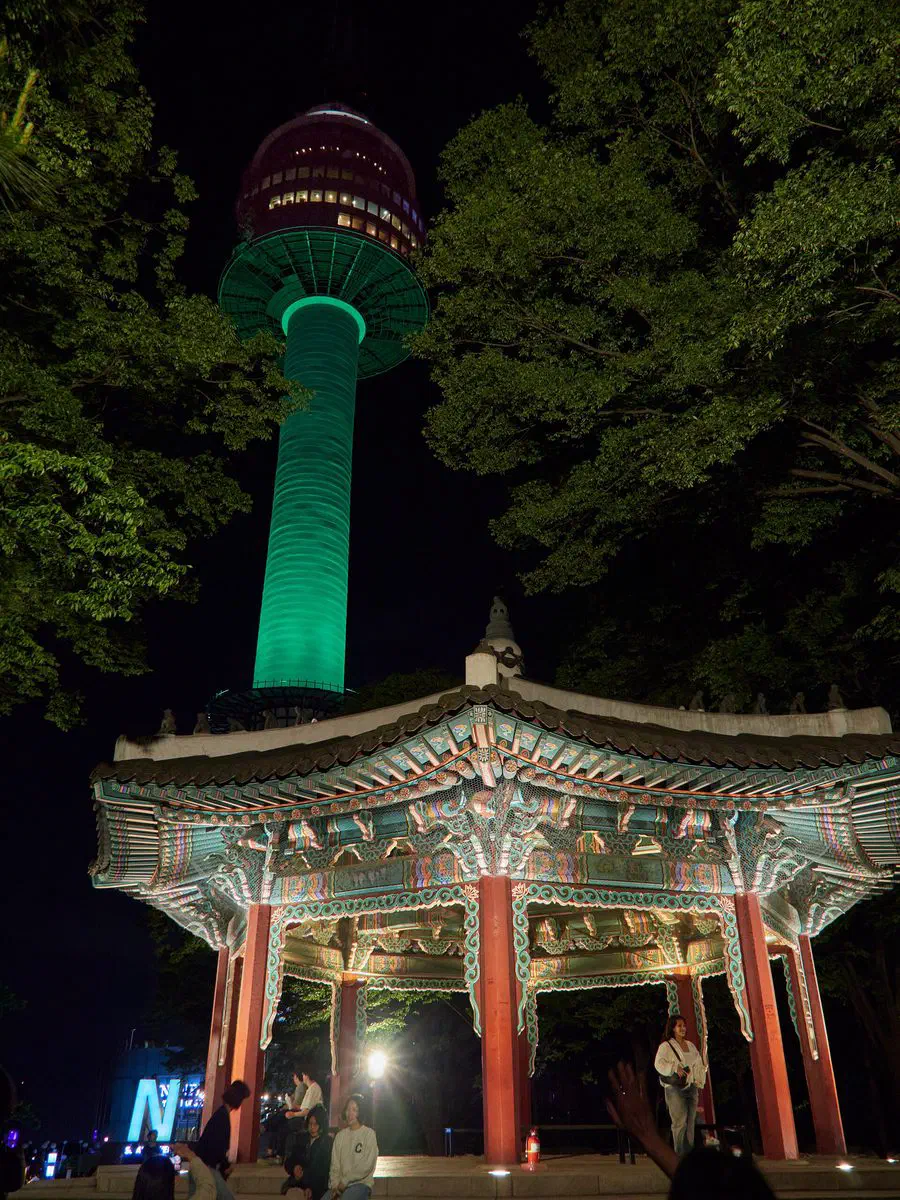
The film’s climax puts the boy group Saja Boys on a stadium stage atop N Seoul Tower for the song “Your Idol.” No stadium exists there in real life — Namsan’s summit has a tower, a plaza, and a pavilion, not a concert bowl. What’s real is everything else: the tower has anchored Seoul’s skyline since 1975, standing 236 meters on a 243-meter peak, with a 360-degree observatory looking out over the city, the Han River, and the surrounding mountains at once.
Adult admission to the observatory runs ₩26,000 (children ₩20,000); the cable car up adds ₩15,000 round-trip for adults (₩11,500 for children), or you can walk. The plaza just below the tower carries its own small landmarks — a “love-lock” fence where couples from around the world have left padlocks, and the path to Palgakjeong, an octagonal pavilion that’s been a couples-and-families walking route for decades, long before this film existed.
Lotte World Tower — Huntrix’s headquarters, seen from the inside
The film models Huntrix’s dorm and headquarters, glowing above the city, on Korea’s actual tallest building: Lotte World Tower, 123 floors and 555 meters, its curved glass silhouette drawing on the shape of Goryeo celadon and a traditional ink brush. The dorm scenes specifically evoke the tower’s real Seoul Sky observatory, around the 117th floor and up — 500 meters up, a 360-degree view, and a glass-floored “Sky Deck” where you can look straight down at the street.
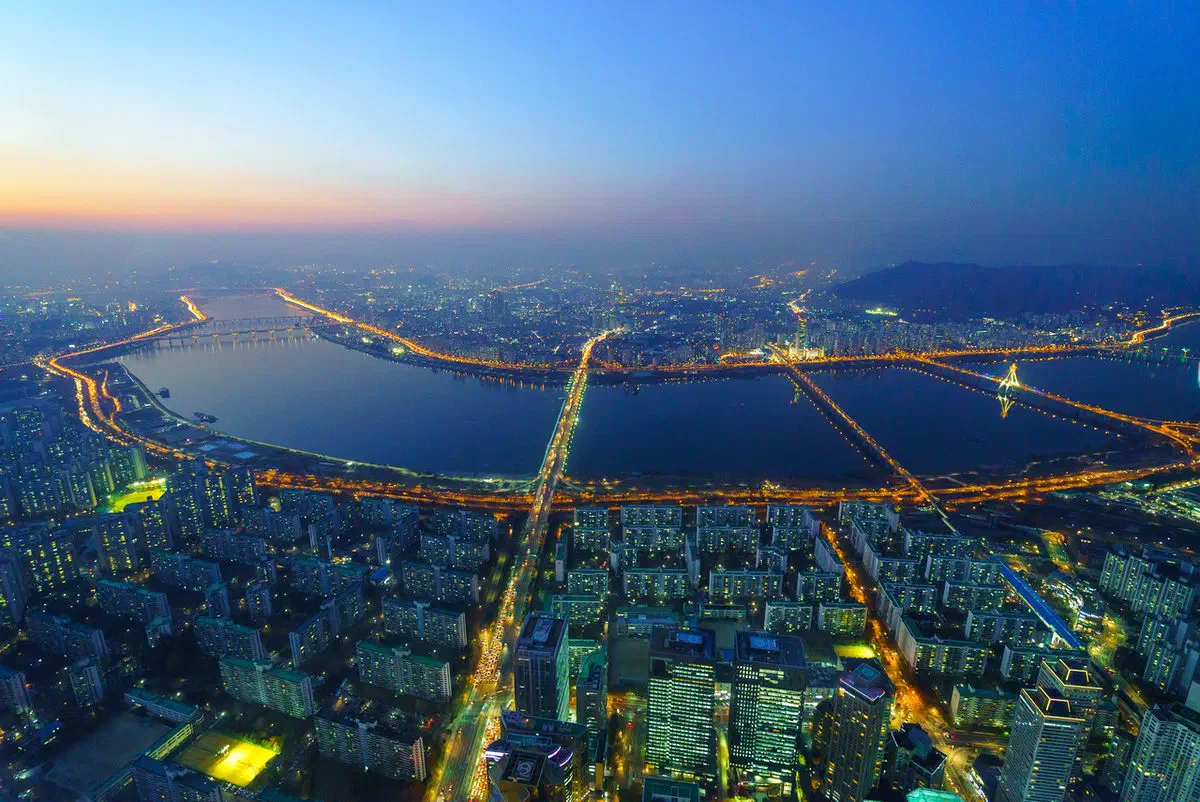
Seoul’s tourism board recommends going up right as the sun sets, when the city’s lights come on one building at a time — “the moment Seoul turns into a stage,” in the words of its own promotional copy for the spot. Seokchon Lake, a short walk from the tower’s base, doesn’t appear in the film at all, but it’s a genuinely popular cherry-blossom and autumn-foliage walk locals already use to pair with a tower visit.
Myeongdong — a specific block, not just “shopping street”
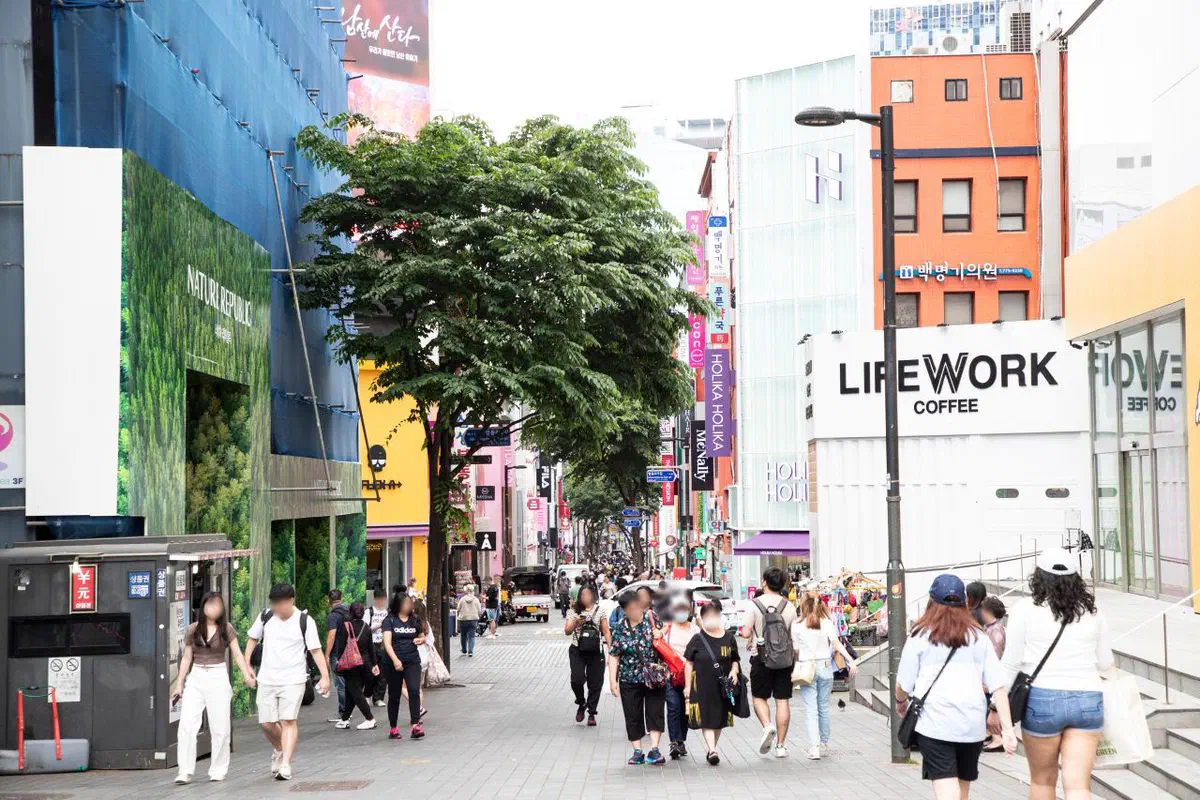
The Saja Boys perform “Soda Pop” on a stretch of Myeongdong so specific that Korean fans matched it to the exact paving pattern: the block around Daiso’s Myeongdong flagship store, on Myeongdong-gil. The film invents the oversized screen at the end of the street — a department store sits roughly in that direction, but not at the distance or angle the animation shows.
Bukchon Hanok Village — a real place with a real noise rule
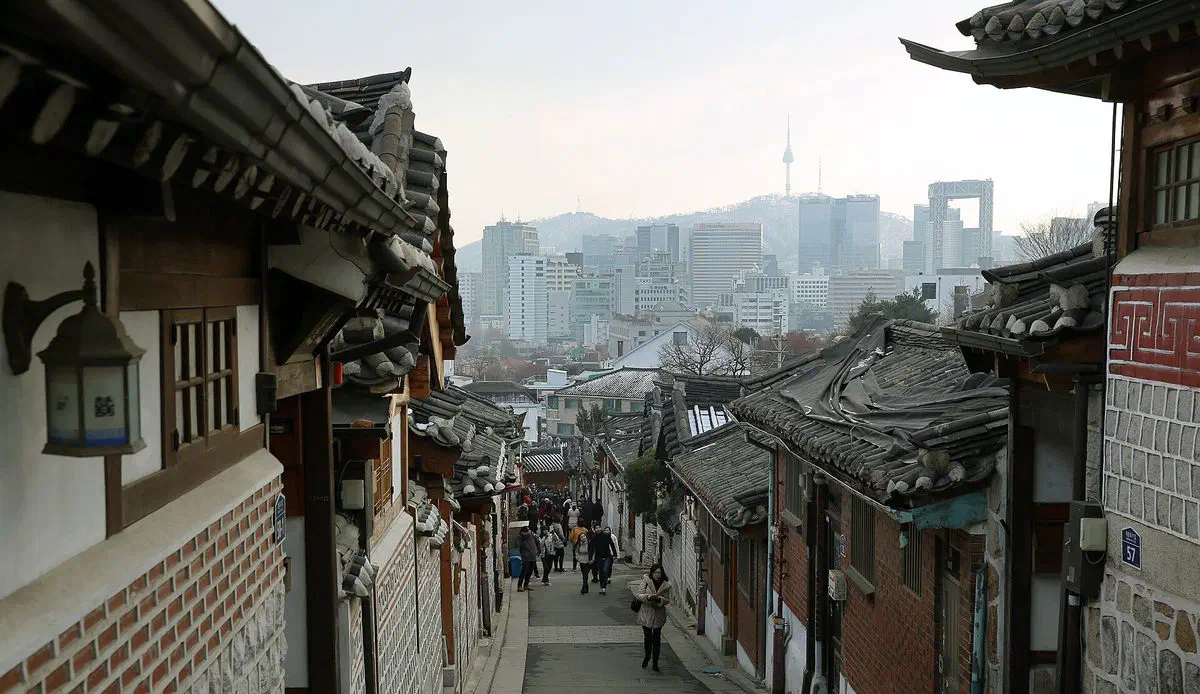
Rumi and Jinu meet twice in Bukchon’s alleys — and Bukchon is a real, lived-in neighborhood with real residents, which matters more here than at most filming-inspired spots. The city restricts visitor access to daytime hours only, 10:00 to 17:00, and singing in the alleys after dark — exactly what the two characters do in the film — brings real neighbors and real police to real visitors who try to recreate it.
Five more KPop Demon Hunters spots around Seoul, without their own photo
Naksan Park, along a restored stretch of Seoul’s old city wall, hosts the second date scene — a real night view over Daehangno and Dongdaemun. Do not climb onto the wall itself for a photo, however convincing other people’s shots look online: safety rules have banned it since the mid-2000s (the wall’s original job was military defense, not Instagram), and some of the “sitting on the wall” shots online are edited composites, not the real thing.
COEX K-Pop Square, at Samseong Station Exit 6, is where the film sets Huntrix’s “Golden” music video premiere — a real, oversized outdoor LED screen using an illusion technique called Wave media art, the same screen genre that’s now widely copied.
Seoul Olympic Stadium in Jamsil hosts the “How It’s Done” performance and the film’s fictional World Idol Awards — production reportedly secured an actual remodeling permit for the stadium to depict a Y-shaped stage design, and the stadium’s real position in the story matches its real-world location exactly, unlike most of the other spots on this list.
Cheongdam Bridge and Jayang Station, on subway Line 7, carry the film’s train-fight sequence — the same double-deck bridge (car deck above, rail deck below) that also appeared in Avengers: Age of Ultron, per Seoul’s own tourism board. Jayang Station appears under a fictional name, but the animators render the platform, train interior, and even the pink priority seats close enough to the real Line 7 that Korean transit enthusiasts have matched them shot for shot.
Seoul Yangnyeongsi Traditional Medicine Center, in Dongdaemun-gu, is the real building behind the film’s dubious “HAN Clinic.” The visitor effect here is the most measurable of any spot on this list: the center’s monthly footfall ran 6,000–7,000 in early 2025, rose to around 10,000 in spring, then jumped to 15,000–20,000 a month in June and July 2025 once the film hit — and it wasn’t a one-summer spike. First-half 2026 visits came in at roughly 97,000, up 53% on the same period the year before, well after the film’s initial buzz had faded from headlines.
- N Seoul Tower
- Saja Boys’ finale stage — real tower, no real stadium — ₩26,000 adult admission
- Lotte World Tower / Seoul Sky
- Huntrix’s HQ — real 555m tower, observatory from ~117F, best at sunset
- Myeongdong (near Daiso flagship)
- Saja Boys’ “Soda Pop” street performance
- Bukchon Hanok Village
- Rumi and Jinu’s two meetings — visiting hours 10:00–17:00, real residents
- Naksan Park
- Second date, city-wall night view — do not climb the wall
- COEX K-Pop Square
- “Golden” MV premiere scene — Samseong Station Exit 6
- Seoul Olympic Stadium (Jamsil)
- “How It’s Done” performance, World Idol Awards — real position matches exactly
- Cheongdam Bridge / Jayang Station (Line 7)
- Train-fight scene — also appeared in Avengers: Age of Ultron
- Seoul Yangnyeongsi Medicine Center
- “HAN Clinic” motif — visits up roughly 53% year-on-year into 2026
Getting there
Every spot above sits inside Seoul’s subway network — nothing on this list requires a car. Our guide to riding the Seoul subway covers fares, T-money and line colors, and Seoul in three days is a reasonable frame if you’re building a trip around more than just this list.
A Korean eSIM is worth having before you go — these nine spots are spread across most of the city, and Naver Map will get you between them faster than Google Maps does in Korea.
Quick answers
Are KPop Demon Hunters' locations real filming sites?
Can you go inside the stadium shown at N Seoul Tower?
Is Bukchon Hanok Village safe to visit because of the film?
Did KPop Demon Hunters actually affect real tourist numbers in Seoul?
Checked 6 September 2026. N Seoul Tower and Lotte World Tower’s role as “soul spots” for the Saja Boys and Huntrix, height and admission details, and the Cheongdam Bridge/Line 7 connection to both this film and Avengers: Age of Ultron, from Seoul Tourism Organization’s official Hallyu tourism pages and its “Golden Tour” itinerary. Scene-by-scene comparisons of Myeongdong, Bukchon, Naksan Park, COEX K-Pop Square, Seoul Olympic Stadium, and the Line 7 train sequence — including the explicit clarification that “filming location” is the wrong term for an animated work — from Korean fan-community location research, cross-checked against the Seoul Tourism Organization pages above where they overlap. The Seoul Yangnyeongsi Traditional Medicine Center’s visitor increase (6,000–7,000/month in early 2025 to 15,000–20,000/month in June–July 2025, and roughly 97,000 visits in first-half 2026, up 53% year-on-year) from Chosun Biz, Seoul Economic Daily (서울경제), and Kyunghyang Shinmun coverage of the center’s own reported figures. Popularity and promotional tie-ins around the film change quickly; the landmarks themselves, their hours and their admission fees are checked separately and may move — confirm before you build a day around any one stop.