Korean Traditional Liquor Types: Four Questions
Last verified: 2026-08-24. Rules and prices change — always confirm on the official site before you travel.
This page contains affiliate links. If you book through them we may earn a commission at no extra cost to you. It never changes what we recommend.
Korean traditional liquor types defeat most visitors at the shelf. Twenty names sit in no obvious order — makgeolli next to yakju next to something called gosori-sul — and nothing on the label tells an English reader how they relate.
Korean traditional liquor types are easier to hold in your head as four separate questions rather than one classification. Each answers something different, and a bottle has an answer to all four.
1. Cloudy or clear
The one you can answer from across the room, and the right place to start.
| Cloudy | Clear | |
|---|---|---|
| Names | Makgeolli, dongdongju, ihwaju | Cheongju, yakju, some fruit wines |
| Why | Unfiltered or coarsely filtered after fermentation | Filtered until the solids are gone |
| Tastes | Rice-forward, soft, a little sour | Cleaner, more aromatic, drier |
| Strength | Roughly 6–10% | Roughly 12–18% |
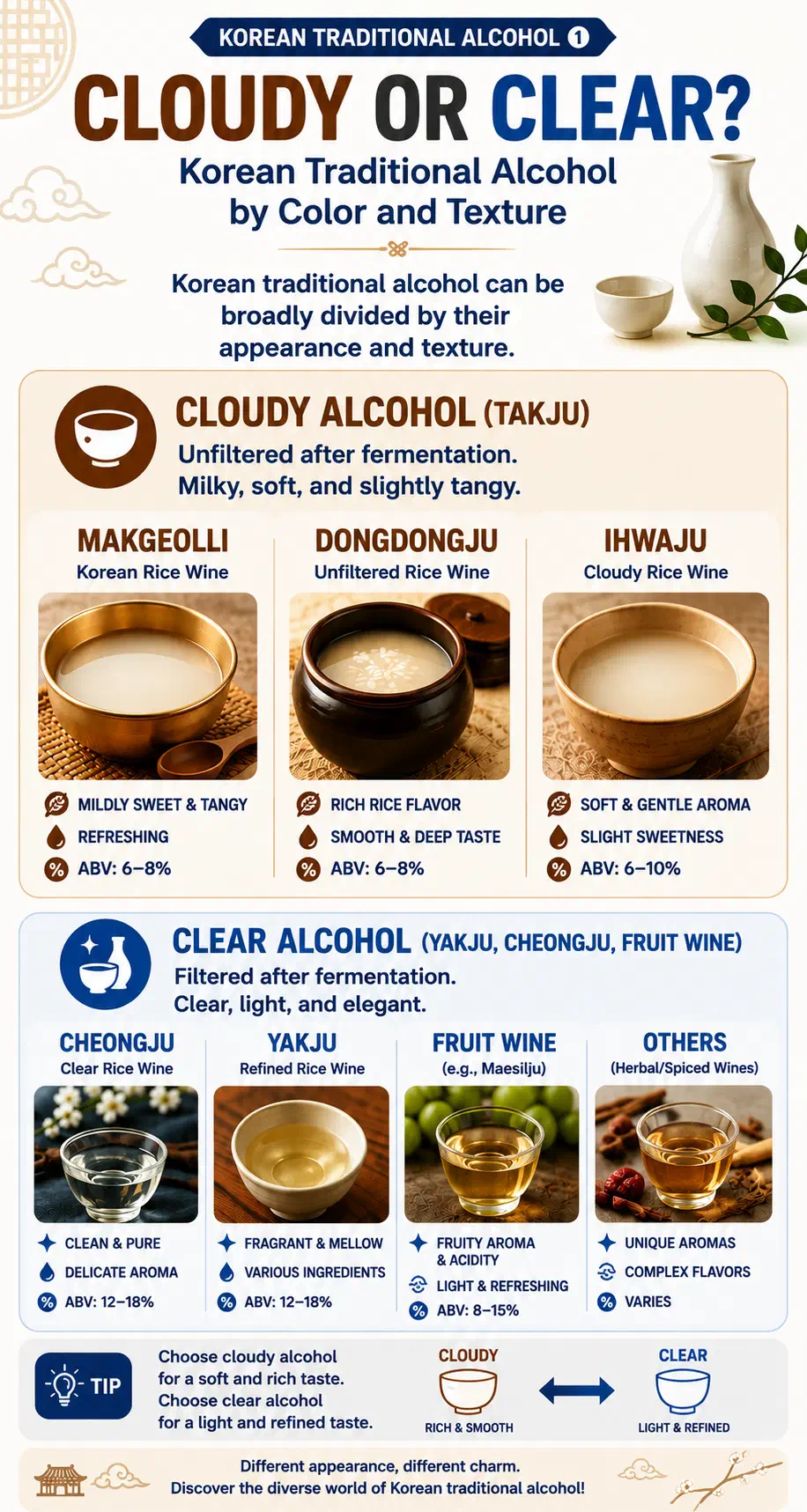
Useful, but do not harden it into a rule. Cloudy does not automatically mean makgeolli, and clear does not automatically mean cheongju — the categories below cut across this one. Treat it as the sorting you do before you know anything else.
2. Fermented, distilled, or infused
This is the technical split, and the one that explains why two bottles both labeled traditional can be 6% and 45%.
| Method | What happens | Examples |
|---|---|---|
| Fermented | Grain or fruit ferments, and that is the drink | Makgeolli, yakju, cheongju |
| Distilled | The fermented brew is distilled again | Andong soju, munbaeju, gosori-sul |
| Infused | Fruit, root or spice added to a base spirit | Igangju, gamhongno |
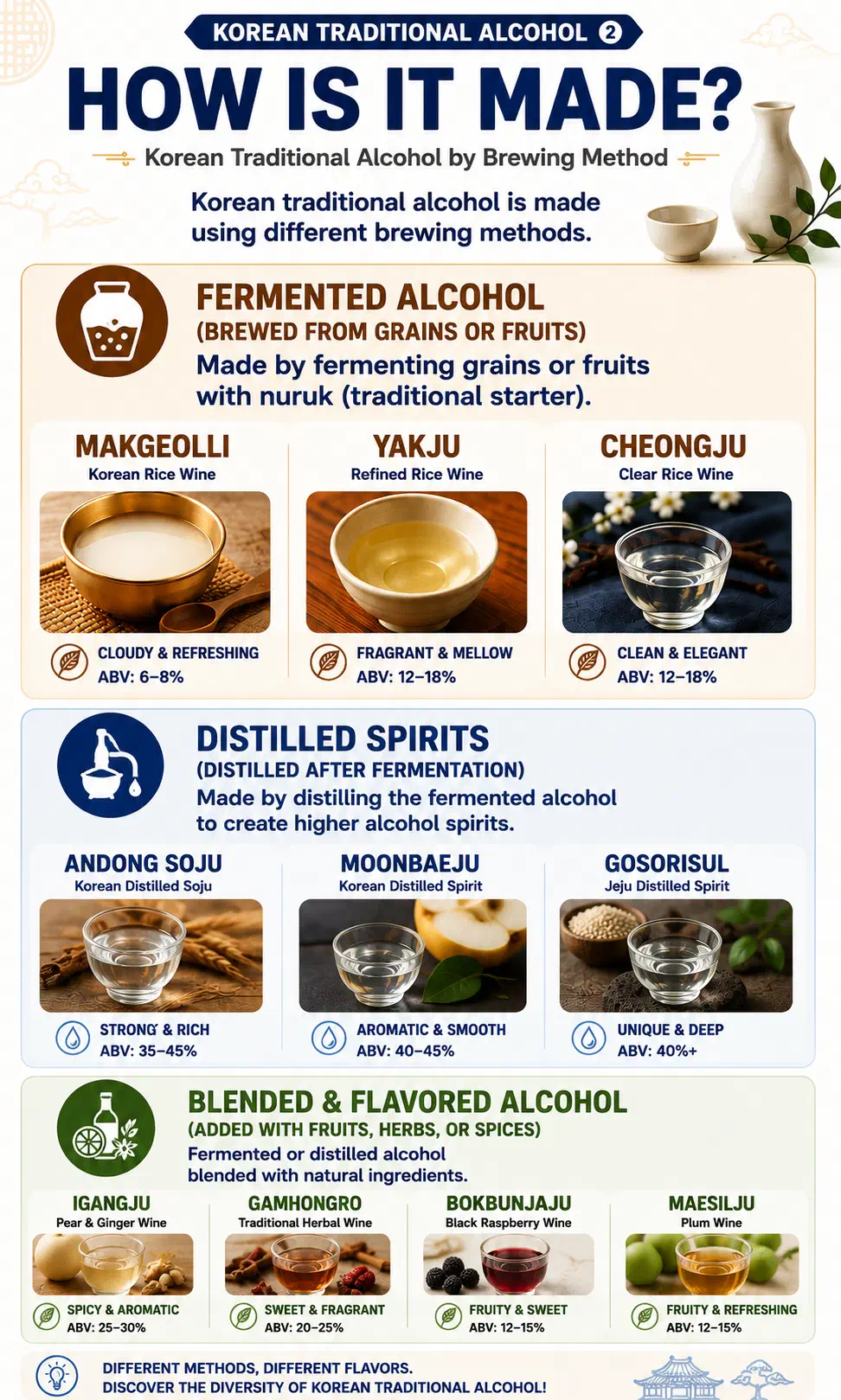
Distilling is not native to Korea. The technique arrived during the Goryeo period with the Mongol occupation, which is how Jeju came to make gosori-sul — millet, barley or sorghum brewed into a cloudy base, then distilled in a vessel called a gosori. It reaches around 40%, and was once ranked with Kaesong and Andong soju as one of the country’s three great distillates.
Strength inside a category varies more than the labels suggest. Andong soju is a 45% spirit by tradition, but producers now bottle 19%, 22%, 32% and 35% versions of the same thing for drinkers who do not want the full weight of it. Read the number on the bottle rather than the name.
The infused category is where the names get poetic. Gamhongno is written with the characters for sweet, red and dew — the last because the distillate beads inside the jar as it condenses.
3. Where it comes from, and what grows there
Regional liquor is regional agriculture. The ingredient list is usually a map of what the county farms.
Three hold national intangible heritage status, designated together in 1986 as part of the traditional home-brewing tradition:
| Liquor | Region | Made from | Note |
|---|---|---|---|
| Munbaeju | Seoul | Grain | National intangible heritage |
| Myeoncheon dugyeonju | Dangjin, South Chungcheong | Glutinous rice, azalea blossom | National intangible heritage |
| Gyeongju Gyodong beopju | Gyeongju, North Gyeongsang | Glutinous rice, wheat nuruk | National intangible heritage · 17% |
Gyodong beopju is a useful example of how slow the traditional method is: two separate brewing stages and roughly a hundred days of low-temperature aging before it is poured, clear and faintly yellow.
The rest of the map:
| Liquor | Region | Made from | Type |
|---|---|---|---|
| Andong soju | Andong, North Gyeongsang | Rice | Distilled — 45% traditionally, 19% up in practice |
| Igangju | Jeonju, North Jeolla | Pear, ginger, cinnamon | Infused |
| Hansan sogokju | Seocheon, South Chungcheong | Grain | Fermented |
| Omegi-sul | Jeju | Millet | Fermented — classed as yakju in law |
| Gosori-sul | Jeju | Millet, barley, sorghum | Distilled, around 40% |
Omegi-sul shows why the legal category and the appearance disagree. It is made from the millet cake Jeju is known for, it does not look like a filtered wine, and the liquor tax law files it as yakju anyway. The label is a legal document before it is a description.
4. What to eat with it
Pairings, not rules. Korean drinking is food-first — the drink is chosen for the table, and the table changes.
| Dish | Usual pour | Why it works |
|---|---|---|
| Jeon — kimchi, spring onion, mung bean pancakes | Makgeolli | Acidity and light carbonation cut through the oil |
| Samgyetang, baeksuk, restorative soups | Insamju (ginseng) | Ginseng aroma against plain chicken |
| Raw fish, seafood, sushi | Cheongju | Delicate enough not to bury the fish |
| Galbi, bulgogi, grilled meat | Distilled soju | Strength resets the palate between bites |
| Galbijjim, jeongol, a full hanjeongsik | Yakju | Aromatic drink for an aromatic table |
These are conventions rather than answers. What actually decides a pairing is sweetness, acidity, strength and aroma on one side against fat, salt, heat and umami on the other — which is why the same fish can take cheongju or a light makgeolli depending on how it is cooked.
Korean traditional liquor types on an actual label
None of these four axes is the same as jeontongju, the legal status that decides tax treatment and online sales. That one is about who brewed it, not what is in the bottle, and our guide to the category works through what it means on a price tag. When you are ready to buy rather than read, the shops that stock it are mostly out in residential Seoul.
The state register at thesool.com lists producers by category if you want to look one up before buying, though it is Korean-language throughout — which, with a Korean eSIM and a phone translator, is workable while standing in front of the shelf.
The fastest way to make any of this stick is to taste across a category rather than read about it. A guided soju and makgeolli tasting pours a range in one sitting with someone explaining the differences in English, and a brewing class shows you what the nuruk starter does — the step that separates every fermented entry in the first table from every distilled one in the second.
Quick answers
What's the difference between makgeolli and cheongju?
What is gosori-sul?
Why does Andong soju come in different strengths?
What food pairs with makgeolli?
Checked 24 August 2026. The three nationally designated liquors, their 1986 designation and Gyeongju Gyodong beopju’s ingredients, two-stage brewing, hundred-day aging and 17% strength from Korean encyclopedia entries on the designations. Gosori-sul’s Mongol-era origin, ingredients, roughly 40% strength and historical ranking alongside Kaesong and Andong soju from the same source. Gamhongno’s name characters likewise. Andong soju’s rice base and typical 45%+ strength, and Omegi-sul’s classification as yakju under the liquor tax law, from Korean reference coverage of regional distillates. Strength ranges in the first table are typical rather than legal limits. Pairings are conventional and stated as such.