Korean Traditional Liquor: Which Bottles You Can Buy Online
Last verified: 2026-08-10. Rules and prices change — always confirm on the official site before you travel.
This page contains affiliate links. If you book through them we may earn a commission at no extra cost to you. It never changes what we recommend.
Korean traditional liquor comes with a rule that makes no sense until someone explains it. In Korea you cannot buy beer or soju online. You can buy certain bottles of makgeolli online, delivered to your hotel. The two sit on the same shop shelf.
The difference is not the drink. It is a legal category called jeontongju (전통주), and it is worth ten minutes because it changes what you can buy, where, and what is worth carrying home. (Not traveling to Korea and just want to know what’s already available where you live? That’s a shorter, different answer.)
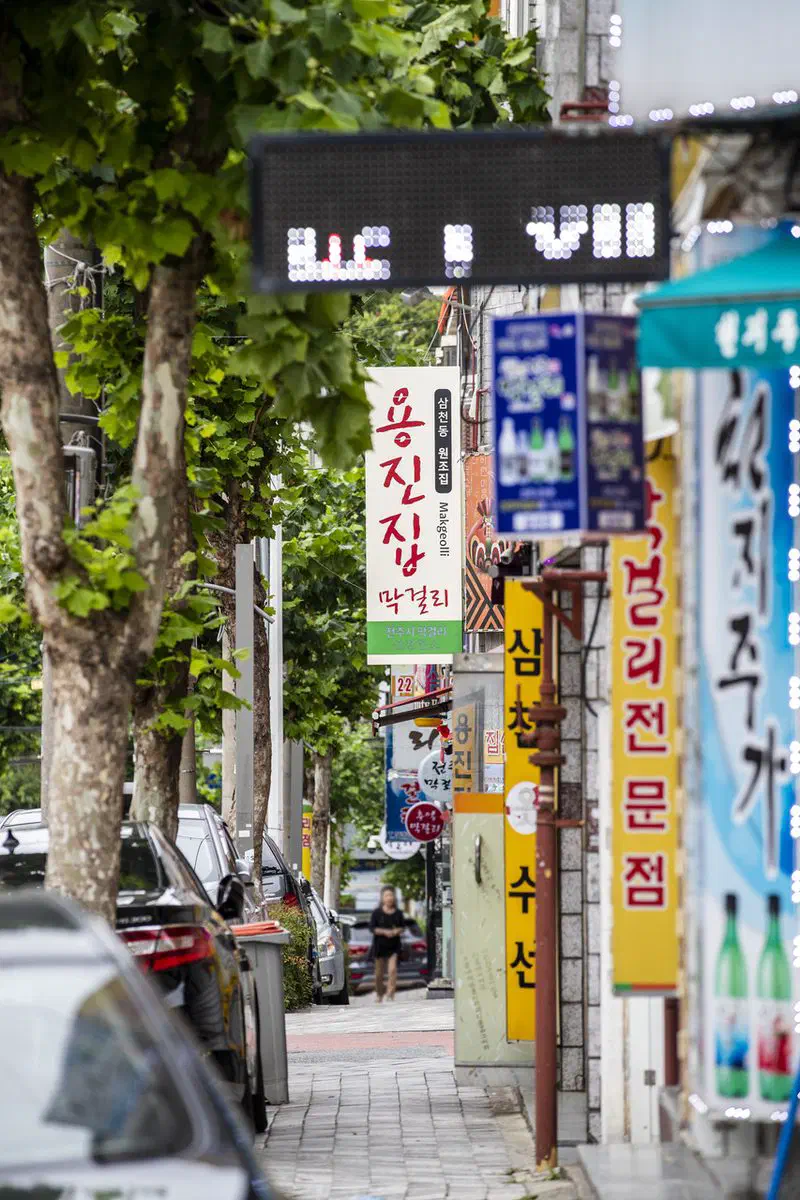
Korean traditional liquor is a category about the maker
Most people assume jeontongju means “made the old way”. It does not. The law defines it three ways, and all three are about who brewed it and where the ingredients came from:
- Heritage holders
- Brewers designated under the intangible cultural heritage law, national or provincial
- Food masters
- Brewers holding the Republic of Korea Food Master designation for liquor
- Local producers
- Registered farm businesses and producer groups, using crops grown in the brewery’s own district as the main ingredient
Nothing there describes flavour, method or age. A drink brewed by hand from heirloom rice using a thousand-year-old technique is not jeontongju if the maker fits none of those three boxes.
Which is why some bottles can be sold online and others cannot
Korea bans online alcohol sales — with an exception carved out for jeontongju, written into the liquor tax rules to support the sector.
So two makgeolli that taste similar and sit side by side in a shop can have completely different distribution rights. Some well-known craft brands — including ones marketed hard on tradition and Korean ingredients — are made by ordinary companies and therefore cannot legally be sold to you online, while a farmhouse brewery’s bottle can be ordered to your accommodation.
If you have wondered why one Korean drinks site will deliver and another only lets you reserve for collection, that is the reason.
The official categories
The government’s own taxonomy, which is what you will see on labels and menus. If you want the fuller picture — cloudy against clear, fermented against distilled, and which region makes what — the four ways to sort Korean liquor lays them out side by side.
The government’s own taxonomy, which is what you will see on labels and menus:
- 탁주 Takju
- Cloudy, unfiltered. Makgeolli is the one you know
- 약주·청주 Yakju, Cheongju
- Clear filtered rice wines, drier and stronger
- 과실주 Gwasilju
- Fruit wines — plum, omija, apple
- 증류주 Jeungnyuju
- Distilled. Includes proper distilled soju, which bears little relation to the green-bottle kind
- 리큐르·기타
- Liqueurs and everything else
The distilled category is where the surprise usually is. Mass-market soju is diluted neutral spirit with sweetener; distilled soju made from grain is a different drink entirely, and priced like one.
Twenty-five of Korea’s food masters work in liquor, out of eighty-eight active across all foods. Bottles from those twenty-five carry the designation on the label, and it is the single most reliable quality signal available to someone who cannot read the rest of it.
Taste it free in Bukchon before you buy
This is the part most guides miss entirely.
The Sool Gallery at Bukchon-ro 18 — a hundred meters or so from Anguk station exit 2 — is run by the agriculture ministry’s marketing corporation to promote Korean traditional liquor. It runs free tastings of a rotating monthly selection, and it runs programs for foreign visitors in English, Japanese and Chinese.
Reporting on the gallery describes hourly sessions across the afternoon, Tuesday to Sunday, with dedicated foreign-visitor and English slots among them. Book ahead — sessions are small and reservation is expected rather than optional.
Two things make this worth building into a day. It is free, and it is a hundred meters from Bukchon and a short walk from Insadong’s craft workshops and the palaces. Tasting five bottles before deciding which to carry home beats guessing at duty free.
It is also the second place we have found that reserves capacity for foreign visitors — the guided garden tours at Changdeokgung do the same. Korea does this more than English-language guides suggest, and it usually works in your favor.
If mid-November lines up with your trip, the Korea Traditional Liquor Grand Festival does at scale what the Sool Gallery does in miniature — over a hundred breweries pouring in one building at Seoul’s aT Center, rather than a rotating monthly selection. Worth treating as an alternative to the gallery rather than an addition to it; a single afternoon does not really need both.
Once you know what you are tasting, the shops that actually stock it are mostly out in residential Seoul rather than the districts you are sleeping in — worth a subway trip, and worth knowing before you settle for a convenience store.
If the Sool Gallery’s slots are full or your Korean is not up to the booking form, a guided soju and makgeolli tasting covers the same ground in English for a fee — a market brewery, a blind flight of ten sojus, and the cheongju that most visitors never get poured. The gallery is still the better value if you can get in. This is the fallback that does not require you to.
Carrying it home
The Korean side is not the constraint; your own country’s allowance is. Check it before you buy, because spirits allowances are small almost everywhere and the fine for guessing wrong is worse than the bottle.
Three practical points that hold regardless:
It goes in checked luggage. The 100 ml cabin liquid limit applies, so anything bought in the city travels in the hold. Bottles bought airside, after security, can be carried on in the sealed bag they come in — keep the receipt inside it.
Makgeolli is the awkward one. Live makgeolli is unpasteurised, still fermenting, and does not travel — it wants refrigeration and a short life. Pasteurised versions exist and are made for export precisely because of this. If a bottle needs to survive a flight and a week in a cupboard, buy the pasteurised one and accept that it is a different, flatter drink.
Distilled bottles travel best. High alcohol, stable, and often in better-protected packaging. Of everything in this category they are the safest thing to put in a suitcase, which is the same logic that makes najeon and other hard goods the sensible souvenirs and ceramics the risky ones.
If you would rather make it
Makgeolli brewing classes run in Seoul and are the same shape as the craft workshops — an afternoon, a small group, something to take away. You will not take home a bottle that survives the flight, but you will understand what the nuruk starter does, which is the part that makes the rest of the category make sense.
Brewing at a working brewery is the version we would book: you mix and pitch your own batch rather than watch someone else do it, and it happens in a brewery that sells what it makes rather than a classroom set up for visitors.
Alley addresses in Bukchon and Insadong defeat Google Maps, so a Korean eSIM and Naver Map are worth sorting first — our comparison covers which.
Quick answers
Why can beer and soju not be sold online in Korea, but some makgeolli can?
What is jeontongju?
Where can I taste Korean traditional liquor for free in Seoul?
Can makgeolli survive a flight home?
Checked 10 August 2026. The three-part legal definition of jeontongju and the online-sales exception from Korean liquor tax law and National Tax Service guidance. Food master counts — 88 active, 25 in liquor — from Ministry of Agriculture, Food and Rural Affairs designation figures. Liquor categories and the Sool Gallery’s address, remit and foreign-language programs from thesool.com, run by the Korea Agro-Fisheries and Food Trade Corporation. Session times are from press coverage rather than the booking system and shift with the season — confirm when you reserve. Import allowances are your own country’s and are not covered here.