Andong: Hahoe Village and the Mask Behind It
Last verified: 2026-08-15. Rules and prices change — always confirm on the official site before you travel.
This page contains affiliate links. If you book through them we may earn a commission at no extra cost to you. It never changes what we recommend.
Most English guides still describe Andong and its Hahoe Village as the hard part of a Korea itinerary — worth it, but a detour that eats a full day each way. That stopped being quite true in December 2024. Korea finished the last unfinished stretch of the Jungang Line and put a fast new KTX-eum train on it. Seoul to Andong now takes about two hours, not the bus-and-transfer half-day it used to.
Hahoe Village is waiting at the other end. People have lived there continuously since the 14th century, and UNESCO has protected it since 2010. It also produced Korea’s most recognized mask tradition — nine centuries-old wooden faces that are now a national treasure and the reason an entire October festival exists.
What the train actually changed
Before December 2024, reaching Andong from Seoul meant an ITX or Mugunghwa train on a slow, partly single-track line. The trip commonly ran past three and a half hours. The new KTX-eum, on the now fully electrified Jungang Line, covers Cheongnyangni to Andong Station in about two hours three minutes, with roughly 18 services a day in each direction — and our rail pass guide covers whether a multi-day pass is worth buying if Andong is one stop on a longer trip.
That is the headline change. It makes Andong realistic as an overnight trip from Seoul, not a detour you build a whole regional loop around. It does not, however, get you to Hahoe Village itself. The village sits about 24 km outside downtown Andong, and Andong Station sits outside downtown too — the fast train solves the Seoul-to-Andong leg, not the last mile. Budget the transfer: bus 210 from the station or bus terminal runs roughly hourly and takes about 70 to 80 minutes. A taxi covers the same distance in around 45 minutes.
Andong’s Hahoe Village, and what its name means
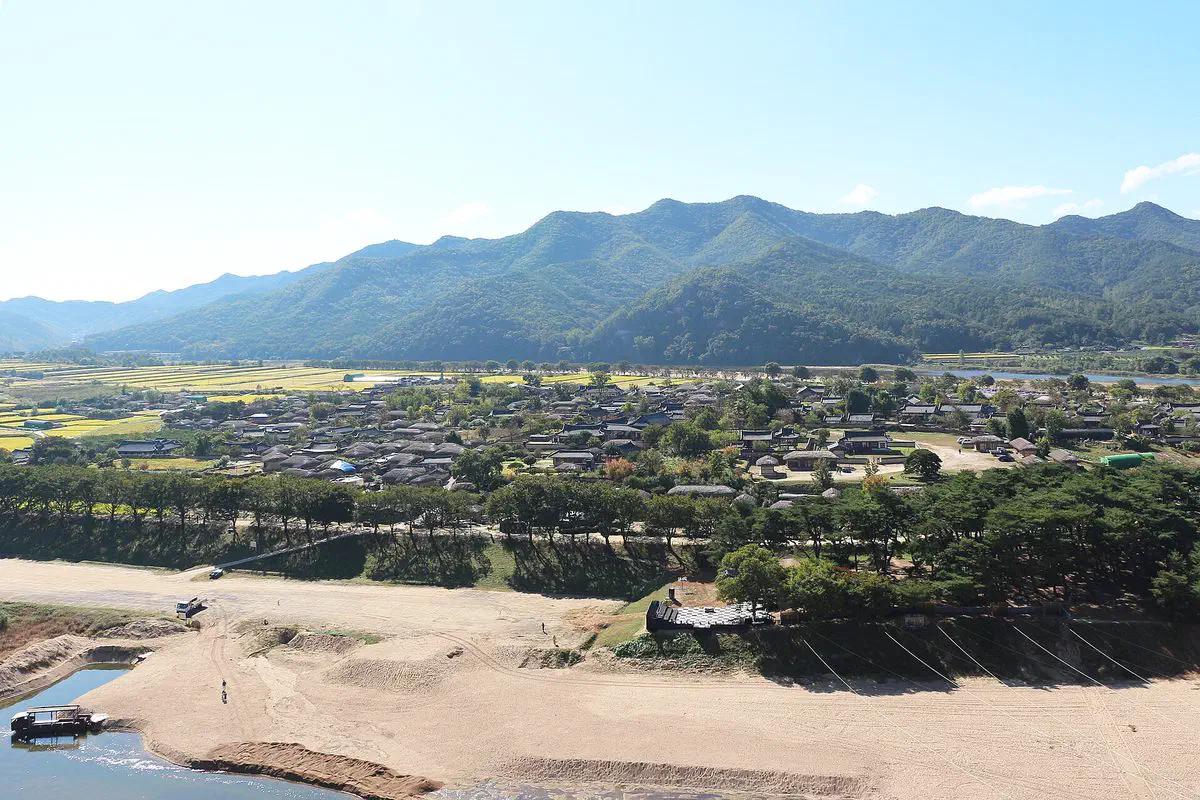
Hahoe (河回) means “river turning back.” The Nakdonggang wraps almost all the way around the village in a horseshoe bend. That bend gives the village its name, and it is also why the site reads so well from above: thatched and tile-roofed hanok sitting inside a loop of water and sand, hills closing the far bank.
UNESCO named Hahoe a World Heritage Site in July 2010, alongside Gyeongju’s Yangdong Village, under the listing “Historic Villages of Korea.” Both are old yangban — noble clan — settlements, still whole. People still live in them; no museum staff preserves an empty shell. Admission runs ₩5,000 for an adult, and the affiliated Andong Folk Museum stays open 9:30 to 18:00.
- Admission
- ₩5,000, adult
- Museum hours
- 09:30 – 18:00
- Mask performance
- Free, Hahoe Byeolsingut Talnori Training Center, near the entrance
- Performance times
- Tue–Sun 14:00–15:00 (Mar–Dec) · Sat–Sun only (Jan–Feb)
The mask behind the village
Hahoe’s other export is talchum, Korean mask dance drama, and the village is specifically where the Hahoetal masks come from — the faces used in Hahoe Byeolsingut Talnori, a satirical nine-act performance said to date to the 12th century, mixing mask drama with a shamanic ritual for the village’s protection.
Carvers cut twelve original masks from alder wood in the mid-Goryeo era. Three went missing over the centuries. The Korean government registered the surviving nine together as National Treasure No. 121 in 1964, and every mask sold today as a “Hahoe mask” still copies their design.
A free performance runs most days at the training center by the village entrance — the recap above has the schedule. Want the larger, noisier version instead? The Andong International Mask Dance Festival runs each late September into October and centers on the same tradition. UNESCO added talchum broadly to its Representative List of the Intangible Cultural Heritage of Humanity in 2022, Korea’s 22nd item on that list.
Confucian Andong, a short trip from the village
Andong calls itself Korea’s capital of Neo-Confucianism, and UNESCO backs the claim. Byeongsan Seowon and Dosan Seowon, both near Andong, are two of nine academies UNESCO grouped together in 2019 as “Seowon, Korean Neo-Confucian Academies.” Each seowon combined a shrine, a library and a school in one riverside compound — private academies built by the Joseon dynasty’s scholar class, not the state.
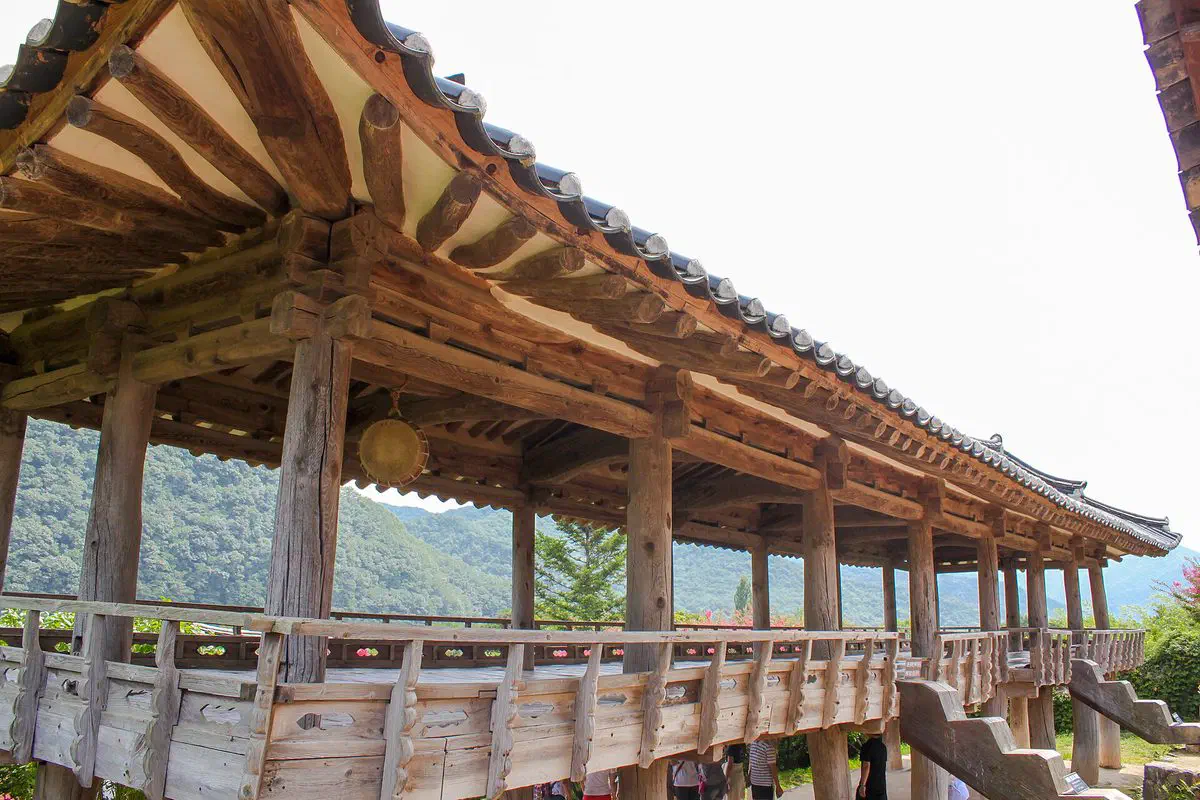
Byeongsan’s centerpiece is Mandaeru, a long open pavilion raised on wooden columns and built with no walls at all, so that the mountain across the river becomes part of the room. It sits a short taxi ride from Hahoe, close enough to combine with the village in one day if you start early.
The bridge with a love letter under it
Wolyeonggyo, a wooden footbridge in downtown Andong, exists because of a letter. In 1998, diggers opened a 16th-century tomb and found a preserved body — a man named Eung-tae Lee. On his chest lay a letter from his pregnant widow, grief written straight to him, asking him to visit her dreams. Beside it lay mituri, sandals she wove from her own hair to send him into the afterlife properly shod. Andong built the bridge in the shape of those sandals. At night it lights up, and the water doubles the arch.
What to eat while you’re there
Andong jjimdak — soy-braised chicken with glass noodles and vegetables — is a genuinely local invention, not an old court dish. It traces to the 1980s and a stretch of Andong’s old market called dak golmok, or “chicken alley.” Stall owners there built it up in large, cheap portions to compete with the fried chicken chains then spreading through Korea. Students and soldiers filled the neighborhood back then, and jjimdak caught on with both. It has stayed the dish outsiders travel to Andong specifically to eat. Pair it, if you drink, with Andong soju — a distilled, clear spirit distinct from the diluted soju sold everywhere else in the country, and a regional specialty in its own right.
Where to stay
Downtown Andong hotels are the easy default, but hanok guesthouses inside and around Hahoe Village itself let you stay past the point the day-trip buses stop running — mornings and evenings when the lanes are empty of everyone but residents.
Stays near Hahoe Village covers both, and Klook’s Andong listings run from downtown hotels to hanok guesthouses:
Bring a Korean eSIM before you go — Andong’s sights are spread out enough that Naver Map, not memory, is how you get between them.
- Getting there
- KTX-eum from Cheongnyangni, about 2h03 (since Dec 2024)
- Last mile
- Station to Hahoe Village, bus ~70-80 min or taxi ~45 min
- See
- Hahoe Village · Hahoe mask performance · Byeongsan Seowon · Wolyeonggyo
- Eat
- Andong jjimdak, Andong soju
- Bigger event
- Andong International Mask Dance Festival, late Sept–Oct
Quick answers
How long does it take to get from Seoul to Andong?
Does the KTX-eum go directly to Hahoe Village?
How much does it cost to enter Hahoe Village?
What are Hahoe masks, and are they still used?
Checked 15 August 2026. Jungang Line electrification, KTX-eum launch and Cheongnyangni-Andong journey time from Korail service announcements and contemporaneous rail reporting. Hahoe Village’s 2010 UNESCO inscription, admission and museum hours from UNESCO’s own listing and Andong city’s own tourism pages. Hahoe mask history and the 1964 National Treasure registration, and the Seowon UNESCO inscription of 2019 including Byeongsan and Dosan, from UNESCO’s Seowon listing. The Eung-tae letter and Wolyeonggyo Bridge from the 1998 excavation record and Andong city’s account of the bridge. Andong jjimdak’s origin in Andong’s old market from Korean food-history reporting. Hours, prices and train schedules change — confirm before you travel.