Busan in Two Days: Fares, Distances and the Zone Trap
Last verified: 2026-08-10. Rules and prices change — always confirm on the official site before you travel.
This page contains affiliate links. If you book through them we may earn a commission at no extra cost to you. It never changes what we recommend.
Planning Busan in two days is mostly a question of geography. The city runs along the coast rather than out from a center, so the distance between two things you want to see is usually larger than it looks — and the fare is sometimes higher than you expect.
Busan in two days starts with the fare structure
Seoul charges a base fare plus distance. Busan charges by zone, and there are only two of them.
- Zone 1
- Under 10 km — ₩1,600 on a card
- Zone 2
- Over 10 km — ₩1,800 on a card
- Children
- Free on a transport card
- QR ticket
- ₩100 more than card in both zones
The trap is where the boundary falls. Haeundae is 12 km from Busan Station, so the beach everybody goes to is on the far side of the line. Most of the rest of what you will do — Jagalchi at 2 km, Gamcheon at 3 km — sits comfortably in zone 1.
T-money works here and earns the transfer discount, so the card from your first hour in Korea carries over — but the rules differ from Seoul’s. Transfers must be tapped within 30 minutes of tapping out, extended to an hour between 21:00 and 07:00, and you get two of them.
Whether the day pass pays
Busan sells passes, and they are worth arithmetic rather than assumption.
For a two-day trip the honest answer is buy singles or use the T-money you already have. The day pass only pays if you are crossing the city repeatedly, and Busan rewards walking within neighborhoods more than hopping between them.
Two days that work
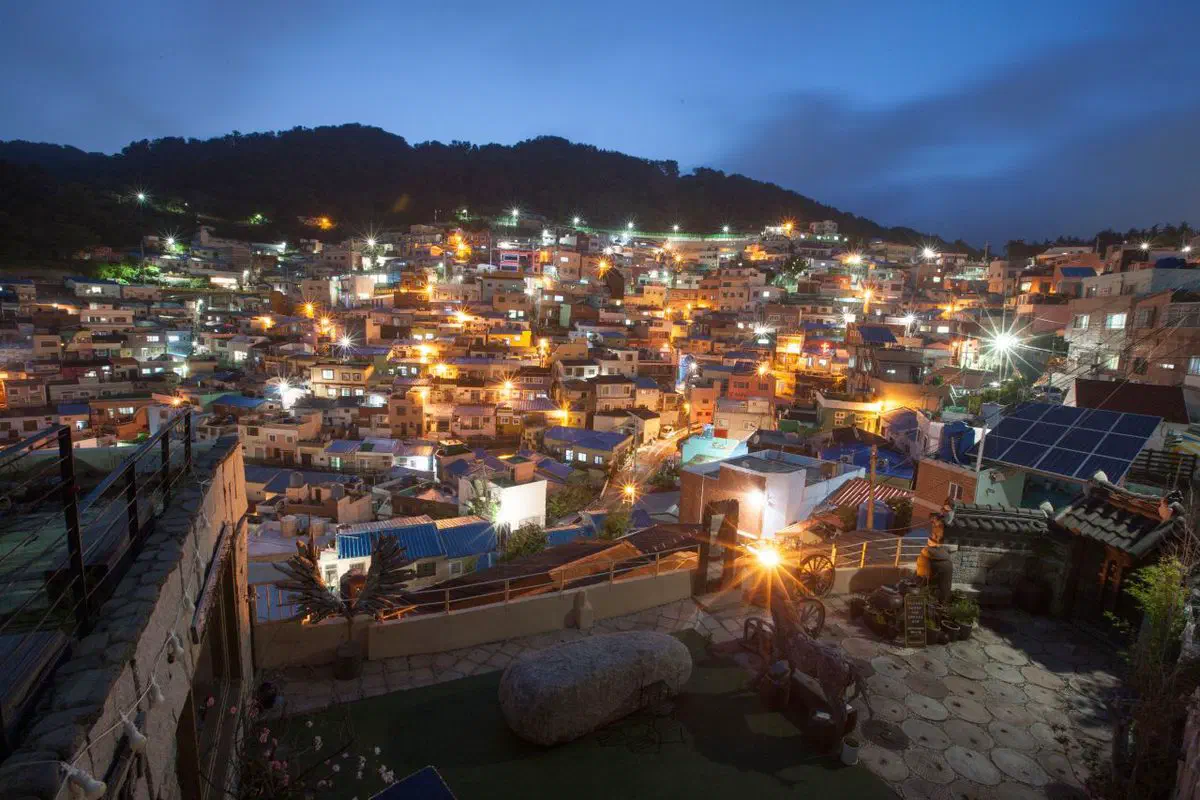
Day one — the west. Busan Station, Jagalchi fish market, Gamcheon. All zone 1, all close together on the map and further apart on foot than that suggests, because Gamcheon is a hillside. The village is stacked in tiers and the walk is up.
Gamcheon is a residential neighborhood before it is a photograph, the same tension Bukchon has and without the enforced hours. People live behind those doors.
Day two — the east. Haeundae, and the coastal walk. This is the zone 2 leg, so budget ₩1,800 each way, and treat it as a half-day rather than a stop.
One reason to come here rather than stay north: cherry blossom reaches Busan about a week before Seoul, so late March works here when it does not there. The seasonal picture sets out the dates.
Arriving
By KTX from Seoul Station, about two hours forty. Whether a rail pass beats individual tickets depends on how many cities you are stringing together — for Seoul and Busan alone it does not.
By air into Gimhae, which is 12 km west of the center and connected by light rail.
By bicycle, which is our readers more often than you would think — and it lands you in the wrong place. The cross-country route finishes at the Nakdonggang estuary barrage in Saha-gu, 8.7 km west of Busan Station and 20 km from Haeundae. That is a ride, not a walk, and you are doing it with a bicycle you now have to get home somehow.
If you are finishing a ride, book accommodation in the west of the city on the last night rather than in Haeundae.
Where to stay
The city’s shape makes this a real decision rather than a preference.
- West · near Busan Station
- Best for arriving and leaving, the markets, Gamcheon, and finishing a bike ride
- East · Haeundae
- Best for the beach and eating, worst for everything else at zone 2 fares
Two nights in one of them beats one night in each. Moving hotels costs you an hour and a fare, and Busan is a city where you can be at the other end in forty minutes anyway.
Rooms appear on Booking.com , Agoda and the rest, and Busan is cheaper than Seoul for the equivalent room.
The practical layer
Addresses here work the same way as everywhere else in Korea, which means the suffix tells you how hard the last hundred meters will be — and Gamcheon is almost entirely gil. Naver Map and a Korean eSIM do the work; our comparison covers which one.
Quick answers
Does Busan's subway charge by distance or by zone?
Is a Busan transit day pass worth buying for two days?
How do I get from Seoul to Busan?
Should I stay near Busan Station or in Haeundae?
Checked 10 August 2026. Zone fares, the 10 km boundary, card and QR prices, free child travel and pass prices from Busan Transportation Corporation. Transfer window and allowance from the same body’s transfer fare guidance. Distances are straight-line, measured from Busan Station, and travel distances are longer. Fares change — confirm before you buy a pass.