What Nobody Tells You About a Hanok Stay
Last verified: 2026-08-08. Rules and prices change — always confirm on the official site before you travel.
This page contains affiliate links. If you book through them we may earn a commission at no extra cost to you. It never changes what we recommend.
English-language listings for a hanok stay sell you the courtyard at dawn, the paper windows, the tiled roofline against the sky. All of that is real.
Korean-language reviews of the same buildings talk about something else entirely. They talk about hearing the couple in the next room. They talk about the bathroom. They talk about mosquitoes.
This piece is built from the second set.
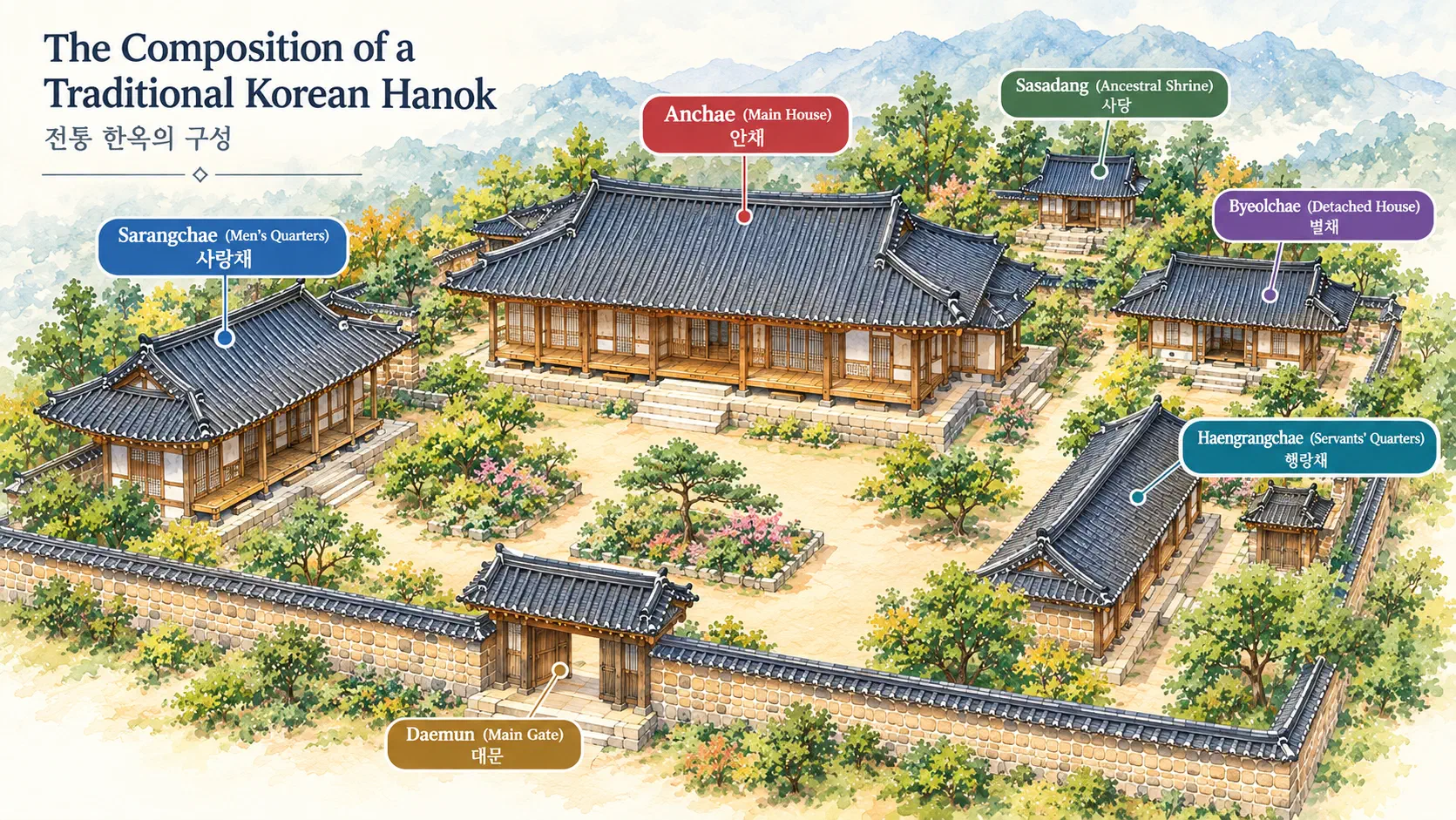
A full traditional hanok was never one building. It was several, arranged around a courtyard and split by function and status — men’s quarters separate from women’s, a shrine for ancestral rites, a row of rooms for servants. What gets booked today as “a hanok stay” is almost always a single piece of that — usually the anchae or the sarangchae — not the whole compound below.
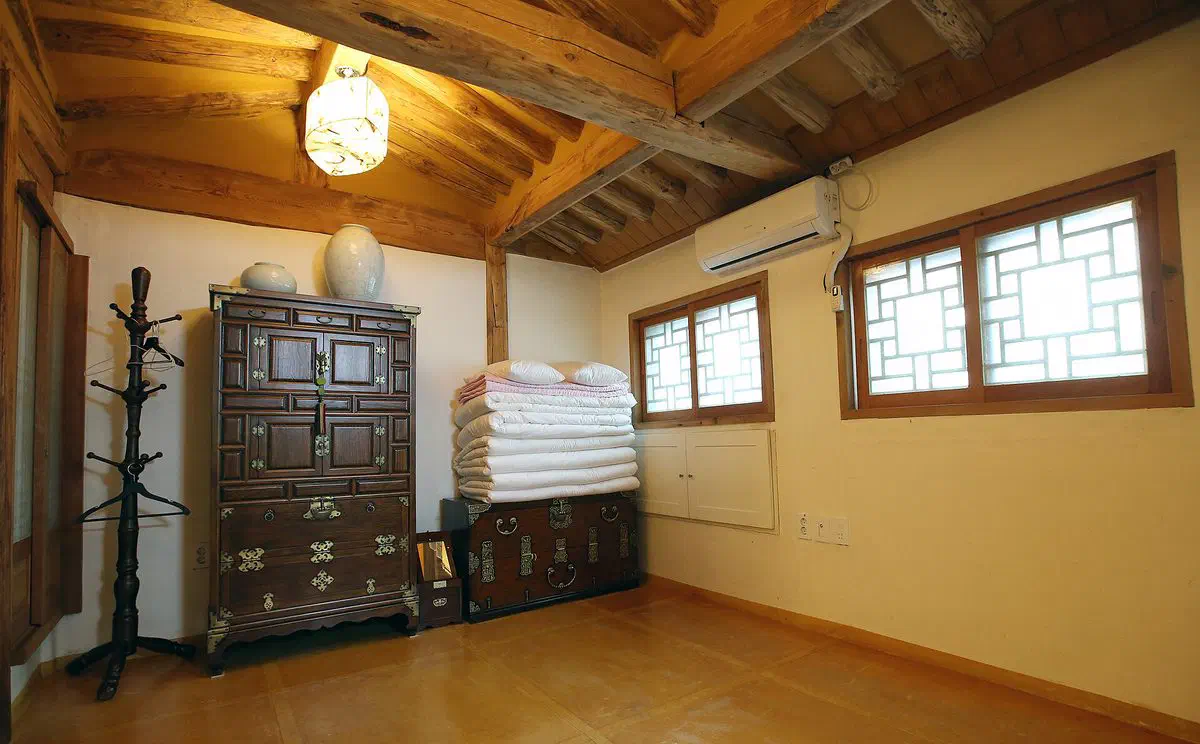
The complaint that comes up most
We read the ten most relevant of 313 Korean-language reviews written for the search “hanok stay disadvantages”. Six of the ten mention sound.
The phrasing is telling. One reviewer of a Jeonju hanok writes that sound insulation is “the common weakness” that their particular stay managed to avoid — meaning it is understood, among Korean travelers, as the default. Another simply notes “not soundproofed” in a list of otherwise glowing comments, the way you would note that a beach is sandy.
The reason is structural. Hanok walls are timber frame packed with earth, and the interior partitions are wood and paper. Sound travels. In a converted house where four guest rooms share what used to be one family’s living space, you will hear your neighbours turning over.
What to do about it. Ask for a room facing the courtyard rather than one sharing a wall with the next room. In listings, a 독채 (whole-house) booking means you have the building to yourself, and it solves this completely.
Bathrooms are where the variance lives
Four of ten reviews raised the bathroom, and they did not agree with each other at all — which is the point.
At the good end, one reviewer described a glass-walled shower and a vessel basin that felt “like a hotel”. At the other, a hanok village stay had the bathroom outside the building, which is traditional and is also a specific experience at three in the morning in February.
In between sit the common complaints: cramped, and a sliding paper-panel door that blocks no sound at all.
This is the single biggest thing to check before booking, and English listings are the least reliable place to check it. Photographs are taken with a wide lens. Look for the Korean words 리모델링 (remodelled) or 신축 (newly built) in the original listing, and if you cannot find them, ask directly whether the shower is enclosed.
Ondol is not central heating
The floor is the radiator. That is the whole system, and it works — but it behaves differently from what you expect.
The floor gets genuinely hot — and it is the floor, not the room. Sleeping close to the wall runs cooler than sleeping in the middle. Air above you can stay cold while your back is warm, which people find either wonderful or strange depending on tolerance.
Bring socks. Ask the host how to turn it down before bed rather than at 3am.
Summer brings its own problems
Mosquitoes appeared in the reviews, with one guest noting they seemed to come in through the bathroom. Old buildings have gaps, and courtyards are outdoors by definition — the doors open onto them.
Humidity is the other half. A hanok’s earth walls do regulate moisture, which is the traditional selling point and is true. It is not air conditioning. Check whether the room has a unit if you are visiting between June and September.
The practical things nobody lists
These came out of the reviews and appear in almost no English listing:
- Parking is often not on site. Several stays share street parking or a lot a few minutes’ walk away. In summer that walk is not nothing.
- Cooking may not be allowed, even where there is a kitchen.
- Towel rails, hooks, shelves — one reviewer noted the only place to hang anything was the bathroom door. Old buildings were not designed around suitcases.
- Getting there with luggage. Bukchon, Seochon and the Jeonju hanok village are alleys, some of them uphill and closed to cars. The lane that looks charming in the photograph is a ten-minute drag with a wheeled case.
How to read a listing before you book
The pattern across all of this is that the important information sits in the Korean text, not the English summary.
- Search the property’s Korean name and read a Naver blog review or two with your browser translating. Korean reviewers list disadvantages as a matter of course, in a section usually headed 단점.
- Look for 독채 if sound matters to you.
- Look for 리모델링 or 신축 if the bathroom matters.
- Check the season. Winter is when ondol is the reason to come. July and August are when the humidity and the mosquitoes are.
- One or two nights. The courtyard at dawn is genuinely worth it. The compromises accumulate after that.
Where to book a hanok stay
Seoul’s hanok stays cluster in Bukchon, Seochon and Ikseondong, and there are 182 of them on the booking platforms. Jeonju has 109 in one village, which is the highest density in the country and makes it the easier first hanok experience. Gyeongju has 52, with the ruins on the doorstep.
Hanok listings on Klook , Booking.com and Agoda all carry them. Note that hotel bookings usually attribute over a shorter window than tours do, so book when you have decided rather than while browsing.
Before any of it, get a Korean eSIM sorted — you will need Naver Map to find the door, because hanok addresses and alley numbering defeat Google Maps. Our eSIM comparison covers which to buy, and craft workshops are a short walk from most Bukchon stays.
Quick answers
What's the biggest complaint about staying in a hanok?
How do I avoid noise problems in a hanok stay?
Is ondol the same as central heating?
What Korean words should I look for in a hanok listing?
Sources checked 8 August 2026. Complaints synthesised from Naver blog reviews of hanok stays in Seoul, Jeonju, Gyeongju and Gongju. Property counts from Booking.com’s hanok category. The sample is small and deliberately skewed toward reviews discussing drawbacks — it is a guide to what to check, not a survey of hanok quality.